





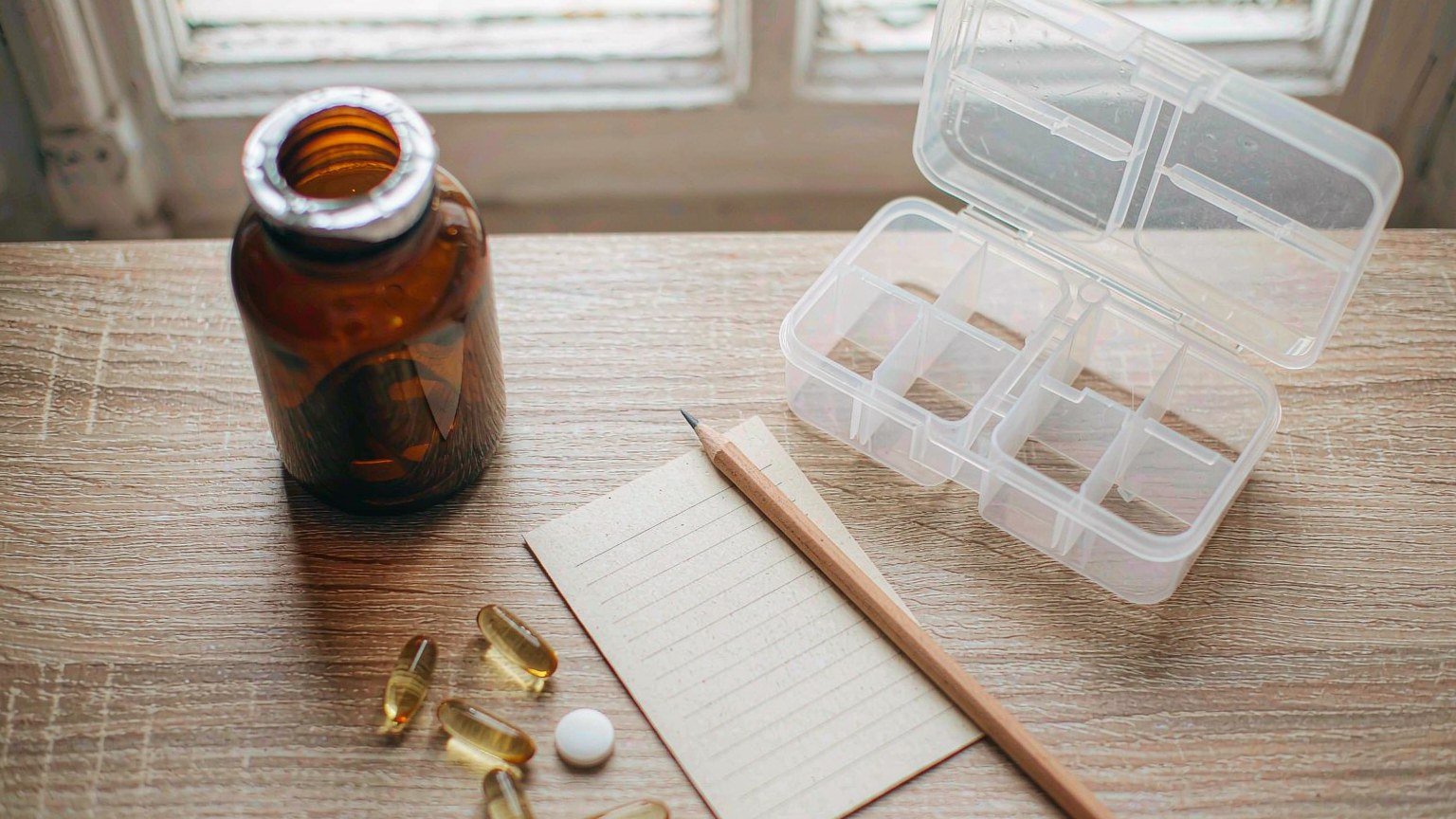
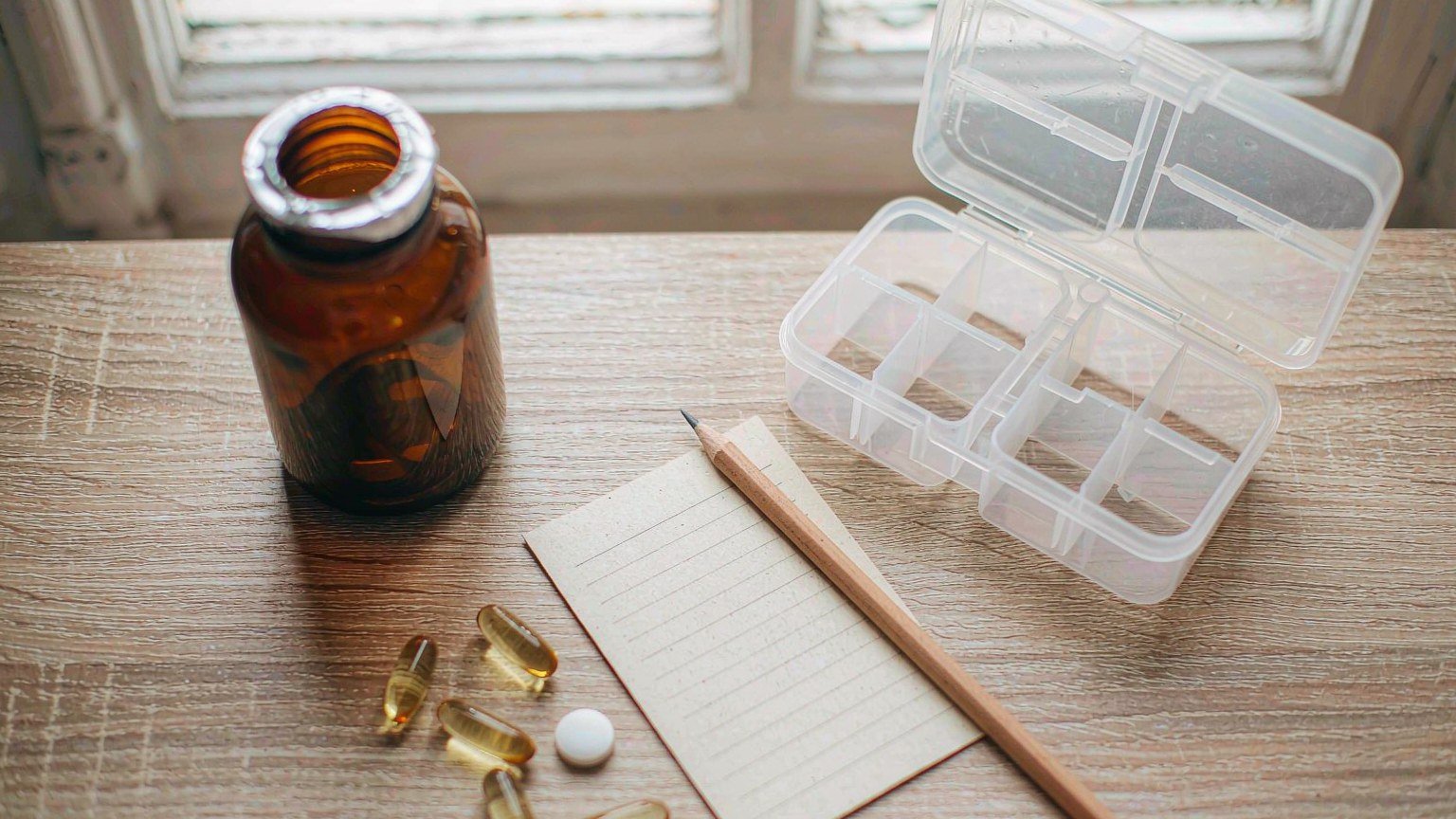
You filled your pill box on Sunday night, and by Thursday two of your fish oil capsules are stuck together in a sticky clump. Or your probiotic capsules look fine, but you’ve felt nothing for a month. Nothing was expired. Nothing was stored wrong in the bottle. You just moved them into a pill organizer — which is exactly what a pill organizer is for.
The uncomfortable part: a weekly pill box is the right tool for some things and the wrong container for others. Moving a supplement out of its original packaging strips away protections the manufacturer built into that bottle — a moisture barrier, a light shield, an oxygen seal. Some supplements survive that just fine. Others quietly lose potency before you ever swallow them.
This guide covers six types that shouldn’t go into a pill box (or should only go in with strict limits), the one “helpful” trick that makes things worse, and how to tell what is safe to pre-sort.
Why a pill box is a different environment than the bottle
It helps to be precise about what changes when you decant.
A supplement bottle is designed as a storage system, not just a container. Quality manufacturers use amber or opaque plastic to block light, an induction seal to keep air out, and often a desiccant liner in the cap to absorb moisture. That combination holds a stable, low-humidity, dark environment around the pills.
A pill organizer does almost none of that. Most are clear plastic, so light gets in. Most are not airtight, so every time you open a compartment you exchange the air inside. And a standard weekly box sits on a counter or in a bag for seven days, being opened at least twice a day.
None of that matters for a hard, dry, coated tablet. It matters enormously for a soft gelatin capsule, a live culture, or a molecule that breaks down in light.
1. Fish oil and other softgel capsules
This is the one people notice, because the failure is visible.
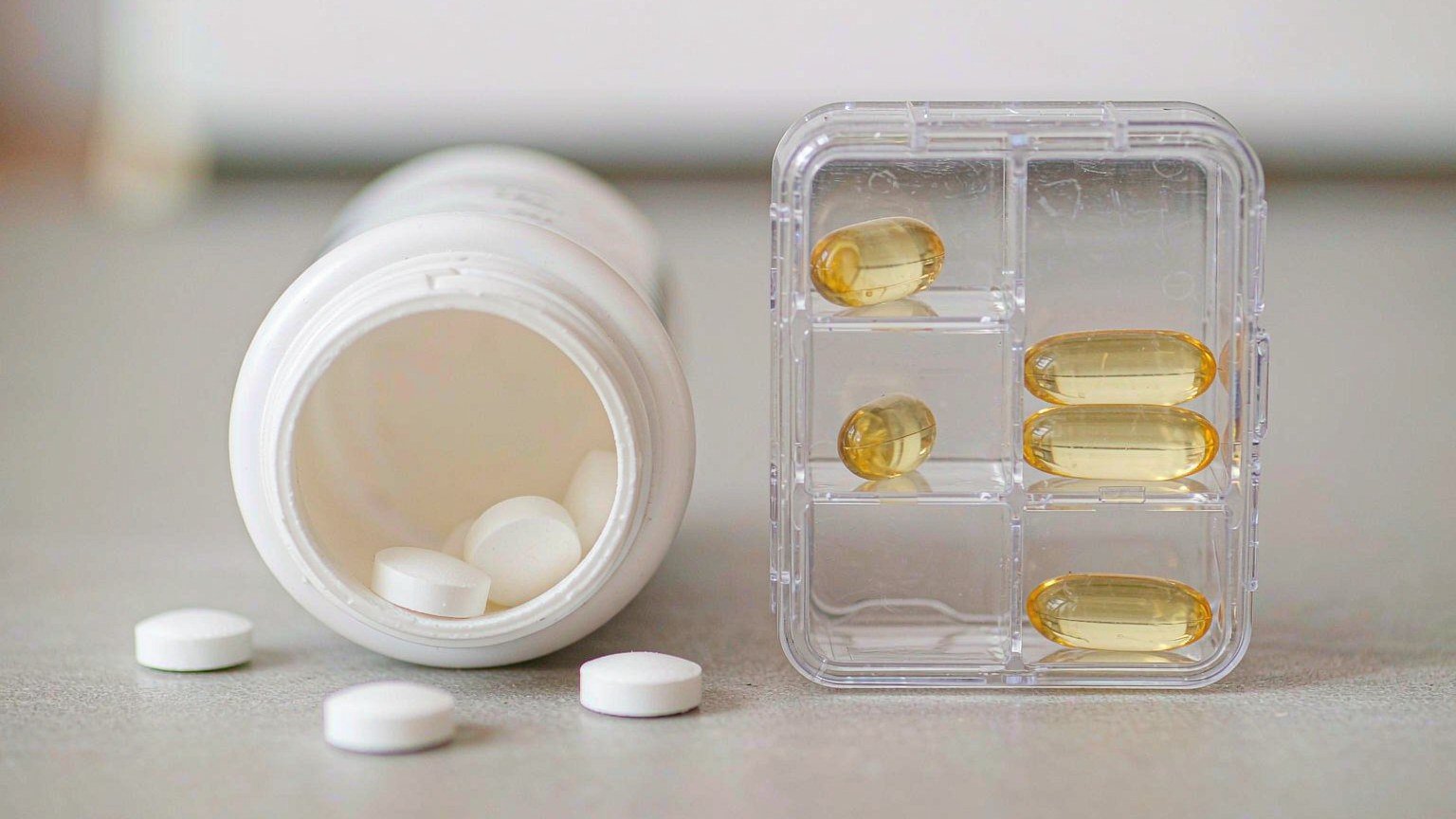
Softgels — fish oil, krill oil, evening primrose, vitamin D in oil, CoQ10 — are built around a gelatin shell that holds a small amount of moisture and plasticizers to stay flexible. When that shell takes on extra moisture from humid air, it softens. Softened shells touch and stick. Shake the bottle and a mild clump breaks apart; leave them in a warm, humid spot and they fuse into a mass, leak, or deform.
Humidity isn’t the only problem. Softgel oils are prone to oxidation, and oxidation speeds up with heat, light and air — all three of which a clear, non-airtight organizer exposes them to. The signs that a softgel has gone too far:
- A strong, sour or acrid smell instead of a faint marine scent
- Capsules leaking oil or leaving an oily film on your hands
- Softgels fused into a hard clump that won’t separate when you shake the container
- Discoloration or cloudy contents
If you see those, the supplement isn’t worth taking — oxidized oil gives you little benefit and an unpleasant aftertaste. The fix is not to move them somewhere else; it’s to leave softgels in the original bottle with the desiccant packet still inside, and to keep that bottle out of the bathroom.
2. Probiotics
Probiotics are live organisms, and the whole point is that enough of them are still alive when you swallow them. Potency is measured in CFU — colony-forming units — and the number that matters is the one at the end of shelf life, not the one printed at manufacture.
Three things kill live cultures in storage: heat, moisture and oxygen. A pill organizer supplies all three. Worse, moisture doesn’t just damage probiotics — it can prematurely reactivate freeze-dried bacteria. Once awake inside a capsule with no food source, they exhaust themselves and die. You end up with a capsule that is within its expiry date and contains almost nothing viable.
There’s an added catch: you often can’t tell. Loss of viability in a dry capsule is invisible and odorless. You may only notice that the supplement stopped doing anything.
If you must pre-sort a probiotic, put out one or two days’ worth at a time — never a full week — and keep the organizer in a cool, dry cupboard rather than a steamy bathroom. The original bottle, with its desiccant liner, remains the better home. Check the label too: “CFU guaranteed through end of shelf life” is a stronger promise than a number qualified as “at time of manufacture.”
3. Effervescent and dissolvable tablets
Effervescent tablets — the kind that fizz in water — are extremely moisture-sensitive. The reaction that makes them fizz starts the moment they meet humidity, and once it starts in the tube, the tablets can soften, swell or crumble before you ever drop one in a glass.
These should stay in their sealed tube or foil until the moment of use. A weekly pill organizer is the wrong container for them, full stop. The same goes for orodispersible tablets designed to melt on the tongue, which are more fragile than standard tablets and often lose stability quickly outside their packaging.
4. Light-sensitive medications
Some molecules break down under light, and this is a safety issue rather than a quality one.
Nitroglycerin, used for angina, is the classic example — it’s unstable and volatile, and it is supplied in a small brown glass bottle for a reason. Pharmacists advise carrying it in that original bottle rather than decanting it into another container or pill case. Because it degrades with repeated exposure to air, moisture and light, the effective life of nitroglycerin drops sharply once you start opening the container regularly.
Other light-sensitive medicines include certain blood-pressure drugs, vitamin K1, and some antibiotics. Many of these are already made with a protective coating or supplied in a dark blister, so the protection travels with the packaging. Move them into a clear organizer and you remove it. If a medicine came in a dark bottle or an opaque blister, treat that packaging as part of the medicine, not as waste.
5. Gummies
Gummy vitamins are a supplement in a candy format, and they behave like one. They’re soft, they contain sugars and moisture, and they absorb humidity readily. In a warm, humid organizer they can sweat, stick to each other and to the compartment walls, and in bad cases grow mold.
Because gummies are also easy to over-consume and often contain sugar, they’re better left in the bottle with the lid closed — not portioned into a week’s worth of open compartments on a counter.
6. Anything with a “protect from light and moisture” label
This is the catch-all, and it’s worth stating plainly: if the label on the bottle gives specific storage instructions — keep refrigerated, store below 25°C, protect from light and moisture — that label describes conditions the manufacturer tested the product under. A pill organizer does not meet those conditions.
Before you decant anything into a weekly box, read the label. If it lists a storage requirement beyond “cool, dry place,” leave it in its packaging and take it from the bottle each day.
The desiccant trick that backfires
This one surprises people, because it sounds like the obvious solution: if moisture is the problem, drop a silica gel packet into the pill box.
In a sealed bottle, a desiccant works. It absorbs the small amount of moisture trapped in that fixed volume and holds the interior dry. In a pill organizer you open twice a day, the desiccant does something different. Every time you open the lid, fresh humid air enters. The desiccant absorbs it — until it saturates. After a few days, a saturated desiccant is no longer absorbing anything; it’s just a damp object sitting in the box next to your pills.
If you want a desiccant to help, it belongs in a container that stays closed — which is the bottle the supplement came in. For an organizer, the more effective move is to pre-sort fewer days at a time and keep the box out of humid rooms.
What is safe to pre-sort
After all that, the picture isn’t grim. Plenty of everyday medicines are perfectly happy in a weekly box.
- Standard dry tablets and capsules with no special storage warning — the coated, hard type most prescriptions come in. These are what pill organizers were designed for.
- Most OTC pain relievers, allergy tablets and common daily medications in solid form, provided they carry no moisture or light warning.
- Anything you’ll take within a few days, even the sensitive types above — the risk scales with time and exposure, so a one- or two-day supply is a different proposition from a full week.
If you take a mix — some tablets that are fine in a box, plus a probiotic or a softgel that isn’t — the practical answer is a split routine. Pre-sort the hardy tablets for the week, and keep the sensitive items in their original bottles, taking them from there. A little extra handling beats a week of pills that quietly stopped working.
For the everyday core of a medication routine, the container matters too. Our guide to choosing a portable pill organizer covers compartment size, day layouts and seal quality — the details that decide whether a box actually protects what you put in it. And if you’re organizing a routine for someone else, our guide to putting vitamins in a pill box picks up where this one leaves off.
For the medicines that do belong in a weekly box, our slide-out aluminum weekly organizer keeps a week’s tablets separated and sealed, with a release that only opens right side up — so the one thing you’re carrying doesn’t spill on the way to taking it. It’s built for the tablets that are safe to pre-sort, and it stays out of the way of the ones that aren’t.
This article is general information, not medical advice. If you’re unsure whether a specific medicine can be removed from its packaging in advance, ask your pharmacist — they can tell you which ones are safe to pre-sort and for how long.