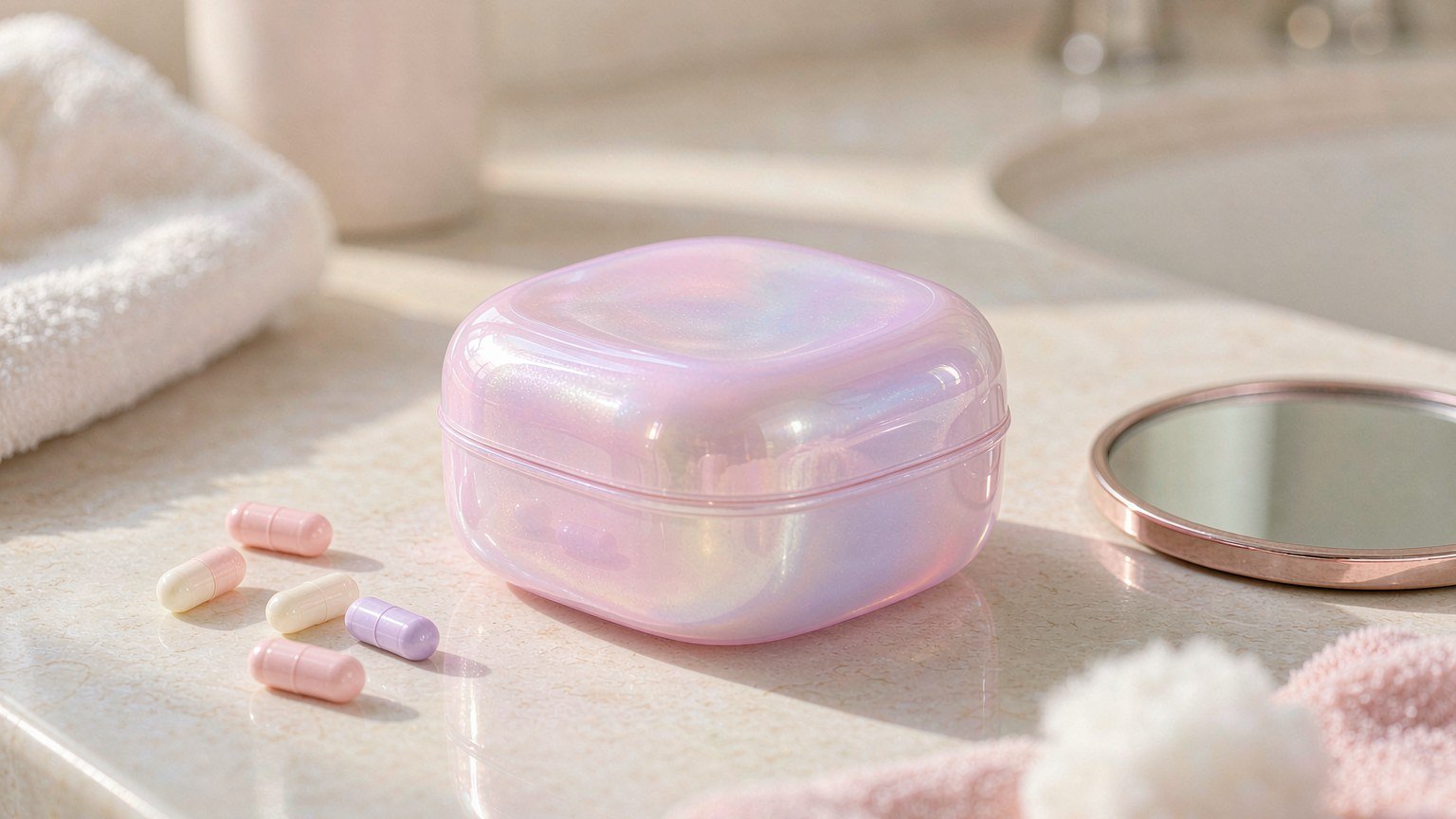






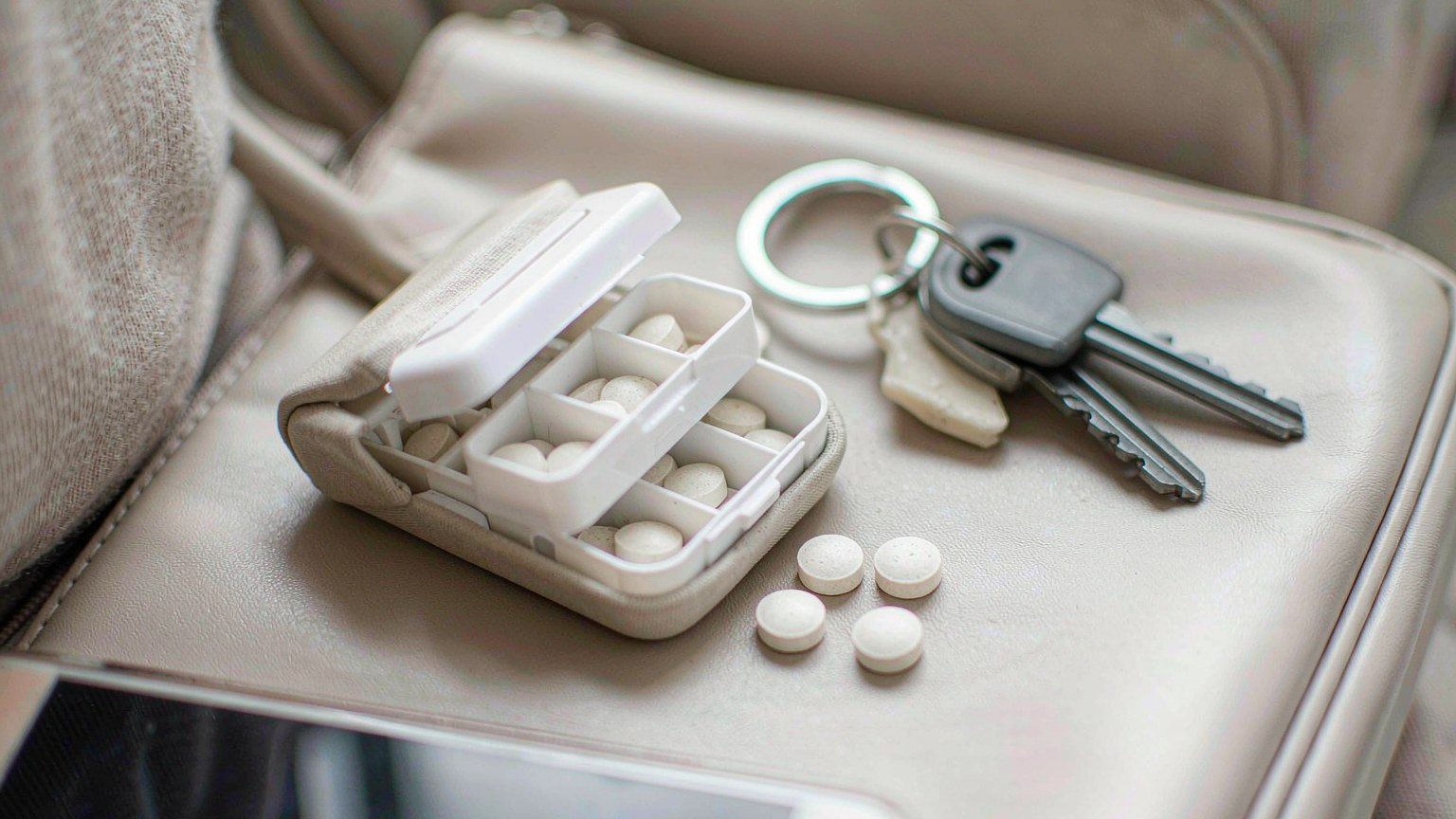
You did not touch it. The pill case went into your bag closed, and somewhere between the office and home it opened itself. Now there are loose tablets rubbing around with your keys, and half of them are ones you cannot identify by sight. If this has happened to you, the box is not “defective” in the way you might think. It did exactly what its lid was designed to do.
Most pill cases are not held shut by a lock. They are held shut by friction, and friction loses to pressure. This article explains the four ways a pill case lid can close, why one of them fails in a bag almost every time, and what to look for if you actually carry your medication with you.
A pill case in a bag is under constant pressure
A case on a bathroom counter sits still. A case in a bag does not. It gets pressed by a laptop, a water bottle, a set of keys and the rest of the weight people carry every day. A thin-walled plastic case flexes under that pressure — the rim spreads by a fraction of a millimetre — and a lid that relied on a tight friction fit suddenly has nothing to grip. The lid does not need to be knocked. The case only needs to change shape for a moment. (InnoLab Design, on why snap lids pop open in a bag)
This is why the complaint is so consistent. One buyer of a weekly planner wrote that the compartments “open way too easily to be a feasible portable solution” and that they had to keep it in a separate ziplock bag “so it won’t spill everywhere.” Another, reviewing an Ezy Dose weekly organiser, said it “pops open way too easy… I wouldn’t carry this with you for sure cause it would end up all over your bag.” (iHerb customer review, June 2026; Woot customer review of Ezy Dose Weekly)
These are not careless users. They bought a box that was never built to stay shut under load.
The four lid types, and which ones survive a bag
Almost every pill case uses one of four closure mechanisms. They trade security against how fast and easy they are to open.
Snap or friction lids. A raised bead on the lid presses past a lip on the base. It is the cheapest to make because the mould needs no side actions or metal inserts. The weakness is fatigue: after a few hundred openings the fit loosens, and the lid starts to lift in a crowded bag. This is the design behind most “popped open in my purse” reviews. (Pill Box Manufacturer, closure guide)
Push-button or spring-assisted lids. A small flexing lever or spring makes a positive lock — you have to press before the lid will lift, so a bump alone will not open it. These cost more and add an assembly step, but they solve the pressure problem directly.
Slide and magnetic lids. A lid captured in a track can only be released by sliding sideways, so squeezing the case cannot open it. Magnets make one-handed opening easy, which many older users and people with arthritis prefer. The trade-off is lateral security: against keys or a phone, a magnetic or straight-slide lid can shift, and some reviews describe these as the first to spill in a backpack. (InnoLab Design, slide-lock vs snap lids)
Threaded or screw lids. The most secure against accidental opening and the best at keeping a seal, but the slowest to use and usually a two-hand job. They suit travel tins and metal cases more than a seven-day organiser you open every morning.

“Stays shut” is a design choice, not luck
There is an old argument that a lid popping open is just a sign you overfilled it or handled it roughly. Overfilling is real — a tablet sitting proud of the rim stops any lid from seating properly — but it is not the whole story. If a case has to be treated carefully to stay closed, it was designed for a drawer, not a bag.
Four things separate a lid that survives daily carry from one that does not:
- Rigid walls. Thin flexible plastic defeats almost any closure, because the whole case bends under pressure.
- Independent lids. One lid over seven compartments means a single failure spills the entire week. Separate lids limit the damage.
- A stop you can feel. A click tells you the lid is closed without having to look — useful when you are dressing in the dark or half awake.
- Depth that fits your pills. A compartment sized for the tablets you actually take lets the lid seat fully.
These are the same checks that matter when you are choosing a portable pill organiser in the first place, and they are why the cheapest box is often the most expensive one to replace.
What the expensive end of the market does differently
The most direct answer to the popping-lid problem comes from a brand built around it. Ikigai makes CNC-machined aluminium pill cases with a patented sliding lid that “clicks into place at each day’s pocket, and it stays shut in your bag.” The company says it started after the founder’s father, who takes pills four or five times a day, could not find a case that was both easy to open and reliable at staying closed. (Ikigai Cases, official site)
That design is not cheap. At the time of writing, Ikigai’s Weekly case starts at $130, the smaller Mission case at $107, and the pocket Nano at $61; the company reports more than 68,000 customers and a 4.9 rating from 9,620 reviews. It also leans on a lifetime warranty and 100-day returns. The metal shell solves the flexing problem outright — there is no thin wall to bend — and the slide mechanism solves the friction problem. (Ikigai Cases, pricing and guarantee)
The trade-off is honest to note. Hands-on reviewers of the metal sliding case point out that the all-metal build adds weight, and that the lid makes a loud metal-on-metal click when it opens and closes. It stays shut beautifully; it is not quiet about it. (Intastravel, travel pill organiser tested review)
The lesson is not that everyone should spend that much. It is that two specific engineering problems — a case that flexes and a lid that relies on friction — are what you are paying to have fixed. Once you know that, you can judge any box by whether it actually addresses them.
What we changed on our own cases
We build our pill cases around the same two problems. The shell is rigid enough that it does not flex and spread the rim when it is pressed in a bag, and the closures are made to hold rather than to rely on a friction bead that loosens with use. Our silent pill box line also addresses the other half of the carry problem: a loose, rattling case announces itself in a quiet room, and a hard plastic snap is often the sound people are trying to avoid. A lid that springs open and a lid that snaps loudly are often the same closure, just failing in two different directions. (More on how lids and shells stop pills spilling)
If your current case has started opening in your bag, it is worth asking whether the problem is the lid design or simply that the box was never meant to leave the counter. Either way, loose unidentified tablets are the one outcome nobody wants, and swapping the container is cheaper than losing a week of medication.

A note on safety
Once tablets leave their labelled bottle, they can be hard for anyone — including a pharmacist or paramedic — to identify by sight. Keep the original bottles and refill your organiser from them. Most weekly trays are also not child-resistant, so store them out of reach of children. This article is general information, not medical advice; talk to a pharmacist about how to store your specific medicines.
Fontes
- InnoLab Design — Why Pill Case Lids Pop Open in a Bag: Slide-Lock vs Snap Lids (Aug 2026)
- Pill Box Manufacturer — Which Latch Actually Stays Shut on the Road
- iHerb — customer review, “Opens too easily” (June 2026)
- Woot — Ezy Dose Weekly customer reviews
- Ikigai Cases — official site, products, pricing and guarantee
- Intastravel — The Travel Pill Organizer That Stays Shut in Your Bag