




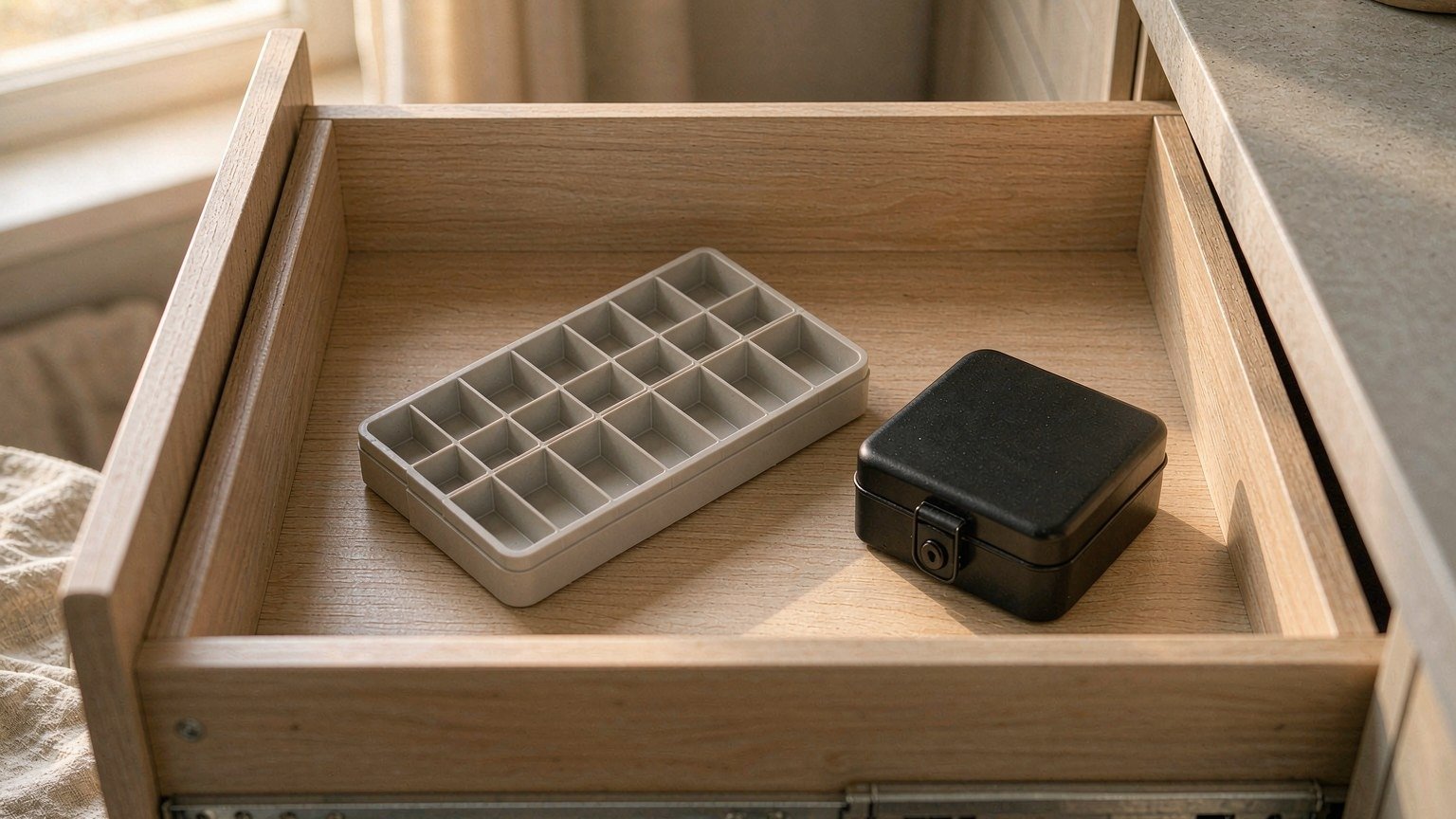
A pill box is built to answer one question: did this dose get taken? The lids are dated, the compartments are labelled, and the entire category is organised around remembering. Reminders, alarms, apps, smart lids that text a daughter when a dose is late — all of it measures the same event.
There is a second question, and almost nothing on the market answers it: who is allowed to open the box? If the honest answer is “anyone in the house,” then what you own is a suggestion with a hinge on it.
That gap matters more than it sounds, because the medicine most worth controlling is usually sitting in a kitchen drawer rather than locked in a pharmacy. This article is about the four situations where access is the real problem, what a lock does and does not fix, and what we are building on our side — including the parts we have not solved.
A reminder answers “did he take it.” A lock answers “who opened it.”
Those are two different products solving two different problems, and it is worth being blunt about the split.
A reminder acts on time. It assumes the person holding the box is the person the prescription was written for, and that the only failure mode is drift — the dose sliding from eight in the morning to ten, then to lunchtime, then to a missed day. Almost every adherence tool on the market, including the connected boxes we have written about before, is aimed at that failure. They notice. Some of them report the noticing to a clinic.
Access control acts on permission. It assumes the dose will be taken on time by the right person, and that the danger is somebody else. That is a different machine, a different set of failure modes, and a different set of trade-offs — one of which is that a lock can create the exact problem the reminder was built to prevent, if the right person cannot get in.
Keeping the two separate is not pedantry. A family that buys a smart box to solve an access problem will be disappointed, and a family that buys a lock to solve a memory problem will be frustrated every morning. They are not substitutes.
The pills are already in the house, and the house is not locked
Start with the supply. The most useful number here comes from a systematic review of opioid prescribing after surgery, published in JAMA Surgery in 2017. Across six studies covering 810 patients and seven surgical procedures, 67 to 92 percent of patients reported unused opioids, and 42 to 71 percent of the tablets they had been given went unused. In the two studies that asked about storage, 73 to 77 percent of patients said their prescription opioids were not kept in a locked container. The authors summed it up in three words that deserve to be quoted: unused, unlocked, and undisposed. (Bicket et al., JAMA Surgery, 2017)
Now connect that to where misuse actually starts. In 2023, nearly 8.6 million Americans aged 12 and older reported misusing prescription opioids in the past year, and of those who misused prescription pain relievers, more than a quarter obtained them from a friend or relative. (CDC, About Prescription Opioids) A quarter is not a rounding error. It is roughly the share of a national problem that begins with a bottle somebody else was prescribed.
US public health guidance already says what to do about it. The CDC’s advice to patients is to store prescription opioids “in a secure place, out of reach of others (including children, family, friends, and visitors),” and not to share or sell them. (CDC, Risks and How to Reduce Them)
Read that sentence again and notice what it does not contain. Secure is an adjective, not a specification. A high shelf is secure until someone grows four inches. A drawer at the back of the wardrobe is secure until a houseguest needs a towel. “Out of reach” is a judgement, and judgements get revised under pressure — a bad night, a bad week, a back that will not bend. A lock is the version of that judgement you do not have to re-make every morning.
Four situations where access is the real question
Locks are not universally good. On a box that holds a week of vitamin D for one person living alone, a lock is cost and friction for no benefit, and friction is the thing that makes people abandon a routine. The case for access control shows up in four specific configurations:
- The prescription is a controlled substance. The legal category already tells you the risk is not forgetting.
- There is a teenager in the house. Not because of who your child is, but because of what a full cabinet offers.
- More than one person does the caring. Rotating helpers make “who gave the last dose” a genuine unknown.
- Memory loss is in play. Here the risk is not a missed dose. It is a repeated one.
If none of those four is your situation, this article is not an argument to buy anything. It is an argument for knowing which problem you actually have.
When the prescription is a controlled substance
Controlled substances are scheduled in the first place because the law has already decided they carry abuse potential, and it treats a Schedule II opioid differently from a Schedule IV sedative for exactly that reason. You do not need the legal detail to act on it, but you do need to accept the premise: with these drugs, quantity and count are part of the treatment, not paperwork around it.
The clearest public guidance is also the most ignored. The CDC tells patients outright not to share or sell prescription opioids. Sharing a tablet with a spouse because “it is the same drug” is still diversion, and it is still how a household supply gets loose. The same logic applies to the leftovers from a surgery that ended three months ago and the bottle nobody has counted since.
What actually helps here is unglamorous. Keep the current fill in the box you use daily, and keep the rest somewhere else, so that a single open lid does not expose a month of supply. Count on refill day, because a count you never take is a count you cannot trust. And if the box has a lock, be honest about who holds access: a lock with four keyholders is a lock that records nothing.
When there is a teenager in the house
This section is not about suspecting your own child. It is about the difference between a decision that takes ten seconds and a decision that requires asking an adult, because that difference is the whole mechanism.
Think about what a cabinet offers. It offers privacy, availability, no transaction, and no person to approach. Epidemiologically it shows up in the data above: a large share of misuse begins with a friend or relative’s supply. Behaviourally it is simpler than that — the easiest option is the one that is already in the room.
Hiding and locking are not the same thing, and the gap between them is where most households lose. Hiding depends on information asymmetry: it works until the hiding place is discovered once, and after that it is worse than nothing, because it now signals that something in there is worth looking for. A lock does not depend on secrecy. It depends on a barrier, and a barrier keeps working after it has been seen.
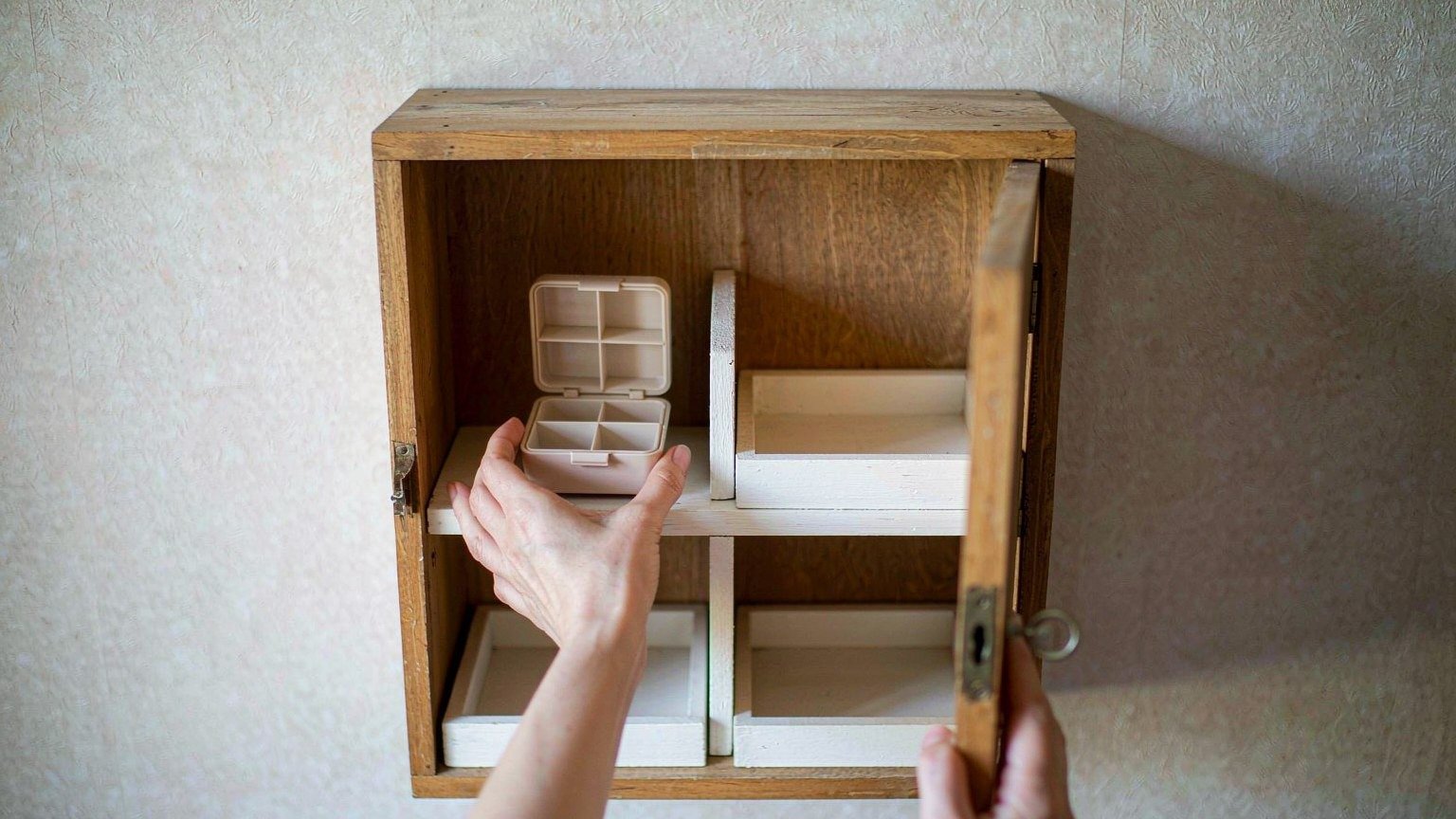
One detail worth getting right: if you lock only the opioid and leave everything else loose, the single locked object becomes a map. Either the box is the secure place for the medication that needs it, or the secure place is somewhere else and the box is not pretending.
When more than one person does the caring
A spouse handles mornings. A daughter covers evenings. A home aide comes three days a week. A visiting nurse checks in after a hospital stay. Each of those people is competent, and none of them can see what the others did.
In this configuration the useful output of a lock is not denial. It is a record. “Was the eight o’clock given?” stops being a memory contest between two tired people and becomes something you can look at. The families who end up in an argument about a bad week are almost never arguing about intent. They are arguing about sequence.
There is a caution attached, and it is not a small one. A log is evidence, and evidence gets used. Before you introduce one, decide what it is for — protecting the person taking the medication, or settling scores between the people giving it. A record that exists for the second reason will make the household worse, and it will not improve adherence. If a care team is involved, agree in writing who reviews the record and how often, so that it serves the patient instead of the argument.
When the risk is taking too much, not too little
Memory loss inverts the usual failure. The person is not skipping doses out of indifference. They are taking a second dose because the first one left no trace they can find — and no amount of reminding fixes a memory that does not record. Repeating the reminder more loudly produces agreement, not accuracy.
Access control changes the arithmetic in a way that reminders cannot: if the box opens once for a scheduled dose, the second attempt fails. The barrier is not a voice asking whether you are sure. It is a lid that will not move.
There is a second effect here that caregivers describe more often than manufacturers do. When the box refuses, the refusal comes from the object. It is not the daughter saying no, again, for the fourth time this week. That shift takes a recurring conflict out of a relationship that has enough of them, and anyone who has cared for a parent with dementia will recognise why that matters more than the mechanism.
The system around the box still matters — one master medication list, one person filling it, a check-off log signed at the moment rather than later. We wrote about how to build that separately, and it is the part that makes any hardware work. (How to set up a weekly pill system for a parent with memory loss)
What a lock does not do
Every claim below is a place where buyers get oversold, including by sellers who mean well.
1. A lock is not child-resistant packaging. The two sound similar and are regulated differently. Child-resistant status comes from a test protocol with child and older-adult panels and specific pass rates — it certifies packaging performance, not the existence of a locking mechanism. A box with a fingerprint reader has not thereby passed anything. We went through what that standard actually measures in a separate article, and the short version is that “it has a lock” and “it is certified” are unrelated statements. (Why pill boxes are hard to open)
2. It does not survive a dead battery gracefully unless someone designed for that. Any electronic lock in a medical context needs a mechanical path that opens the box from the outside, and that path has to be documented where the user can find it at 7 a.m. A lock that fails closed is not a safety device. It is a sealed container with a dose inside.
3. It fights humidity, and humidity usually wins. A fingerprint window wants to be exposed to a dry finger; a moisture-controlled box wants to be sealed against the air. Those two goals pull in opposite directions, and a box that claims both needs a physical separation between the sensor cavity and the pill cavity. If a product page claims dry storage and a biometric reader without describing that separation, ask how.
4. It does not read every finger equally. This is the uncomfortable one. Sensor performance depends on the fingerprint, and fingerprint quality declines with exactly the things that come with age and with certain jobs: thinner skin, worn ridges, dryness, and the loss of the padding that keeps a fingertip in firm contact. Wet hands, cold hands and cracked winter skin all make it worse. The population that takes the most medication is the same population that reads least reliably. Any design that ignores this produces a box that works in a demo and fails in a kitchen.
5. Locking the whole box is not the same as controlling each dose. A whole-box lock asks for one authorisation per session, and inside that session the user has access to everything. Per-compartment locking is a genuinely different machine: more actuators, more failure points, more cost, and a much harder mechanical problem in a box that has to stay pocket-sized. Most of the “smart pill box” category quietly chooses the first and markets it as the second.
What we are building, and what we have not worked out yet
We are building a fingerprint pill box. It is in development. We are not going to publish a release date, a price, or a specification sheet here, because those numbers will change and a pre-launch article is a bad place to make promises you will have to walk back.
What we are willing to commit to as decisions, not aspirations:
- Whole-box locking first. One authorisation opens the box. Per-compartment locking is the more interesting product and the worse first product.
- A mechanical override that opens from the outside, documented in the box, not hidden in a service manual.
- Local storage only in the first version. No account, no cloud sync, no adherence dashboard. Once a device records who took what, it starts collecting health information, and that is a commitment we would rather make deliberately than as a feature bullet.
What we have not worked out, stated plainly, because a manufacturer who claims to have solved all of this has not thought about it:
- How to keep the sensor cavity dry without giving up the dry storage the rest of our line is built on.
- What happens to a person with worn prints after three failed reads — every fallback we have sketched either locks out the person who needs the dose or teaches them a habit that defeats the lock.
- Whether a per-compartment version is worth the mechanism cost at a size that still fits a bag.
We already make a lock, and it solves a different problem. The Silent-Lock lid on our One-Sip bottle keeps the lid shut one-handed and does it without noise. It is a closure, not a security device, and we are not going to relabel it as one.
If your situation is one of the four above, tell us which one. It genuinely changes what we build next, and it is the most useful thing you can send us before a product exists. (Contactez-nous)
This article is general information about storage and access, not medical advice. Decisions about controlled substances, dosing schedules and who should supervise them belong to your prescriber and pharmacist. If someone in your household is misusing medication, the SAMHSA National Helpline in the United States is 1-800-662-HELP (4357), free and available around the clock.
Sources
Bicket MC, Long JJ, Pronovost PJ, Alexander GC, Wu CL. Prescription Opioid Analgesics Commonly Unused After Surgery: A Systematic Review. JAMA Surgery. 2017;152(11):1066-1071.
Centers for Disease Control and Prevention. About Prescription Opioids (misuse and source-of-supply figures from 2023 national survey data).
Centers for Disease Control and Prevention. Risks and How to Reduce Them (storage, sharing and disposal guidance for patients).
US Code of Federal Regulations. 16 CFR Part 1700 — Poison Prevention Packaging, for the distinction between child-resistant packaging certification and a locking mechanism.