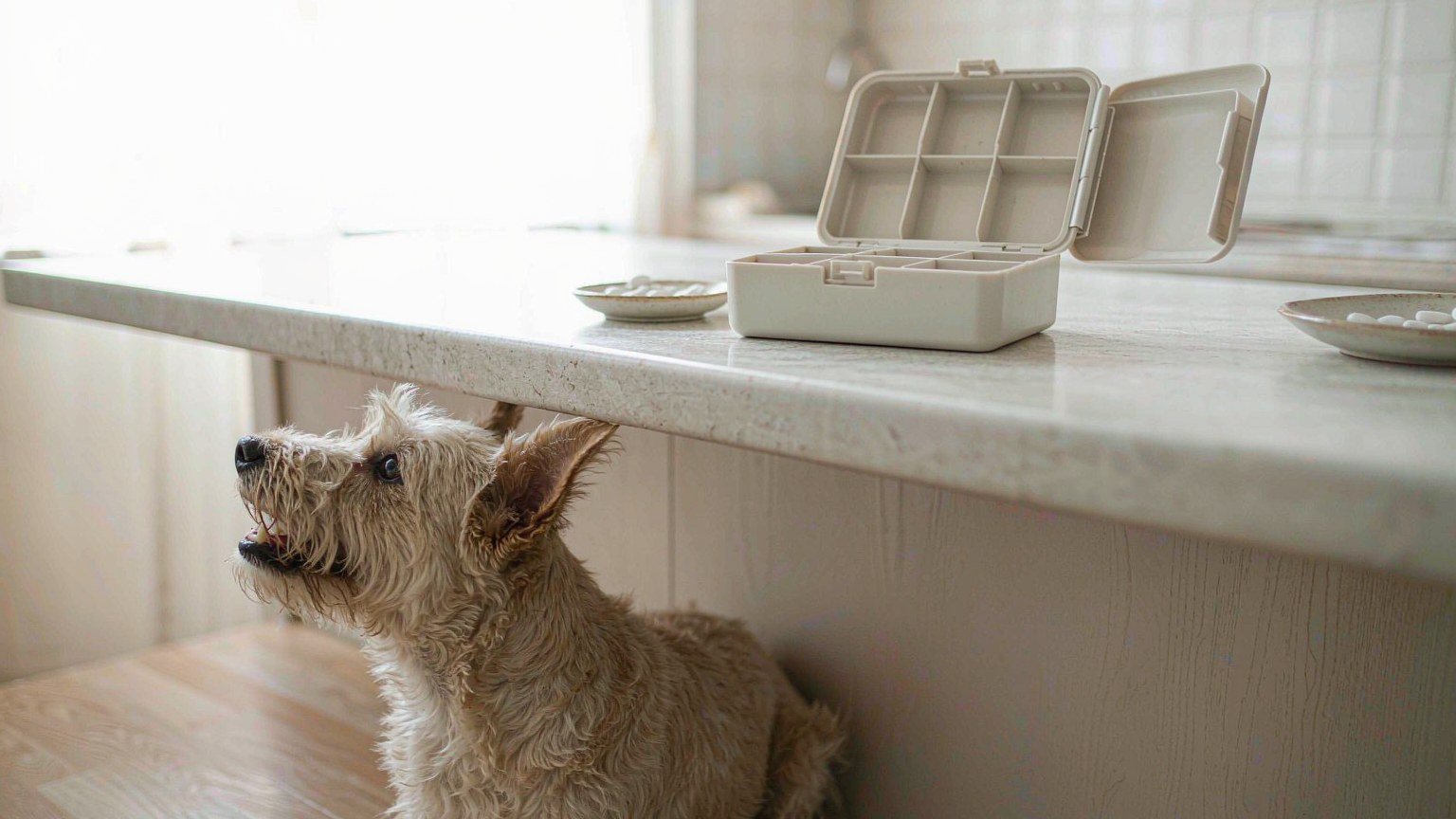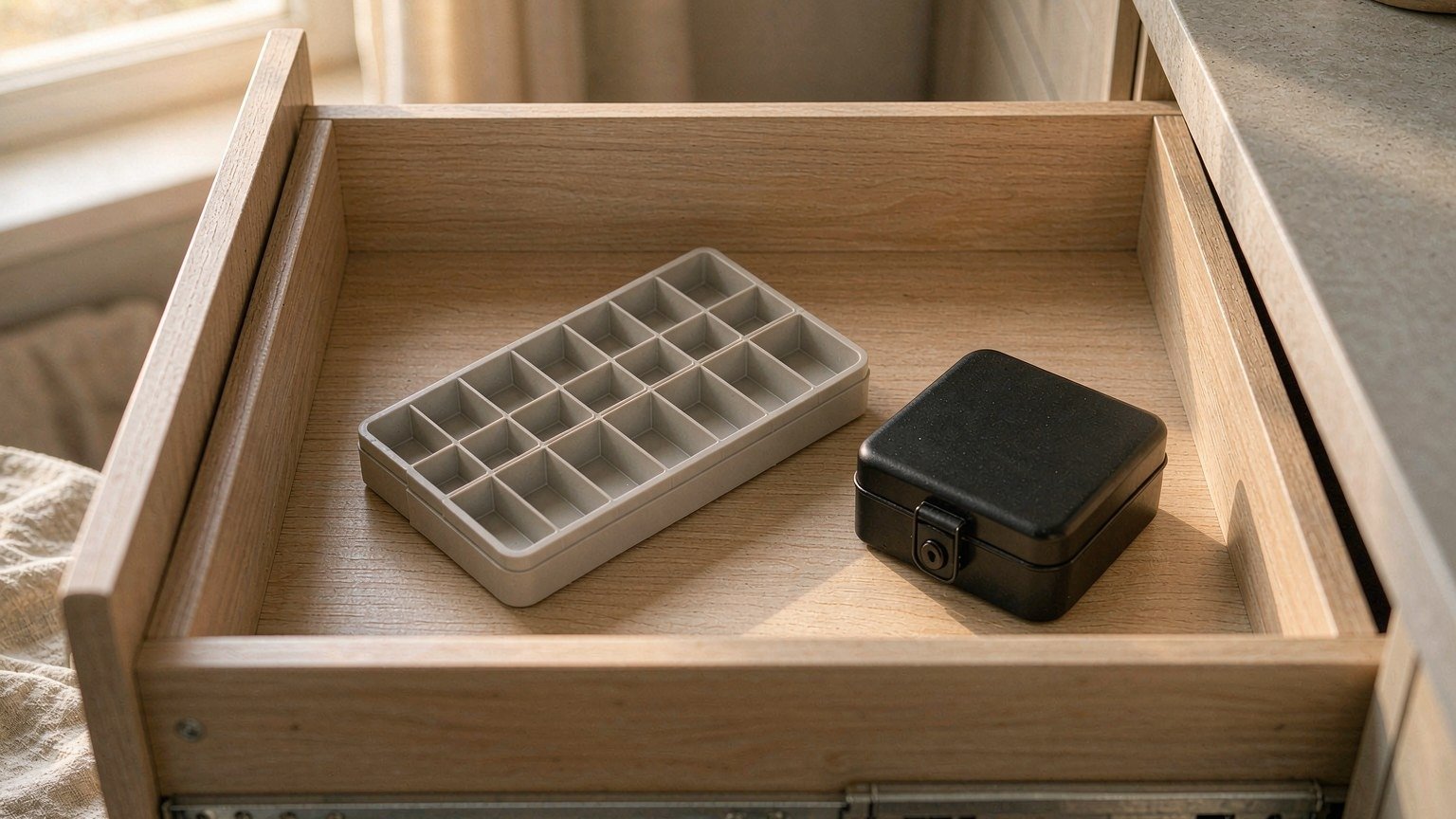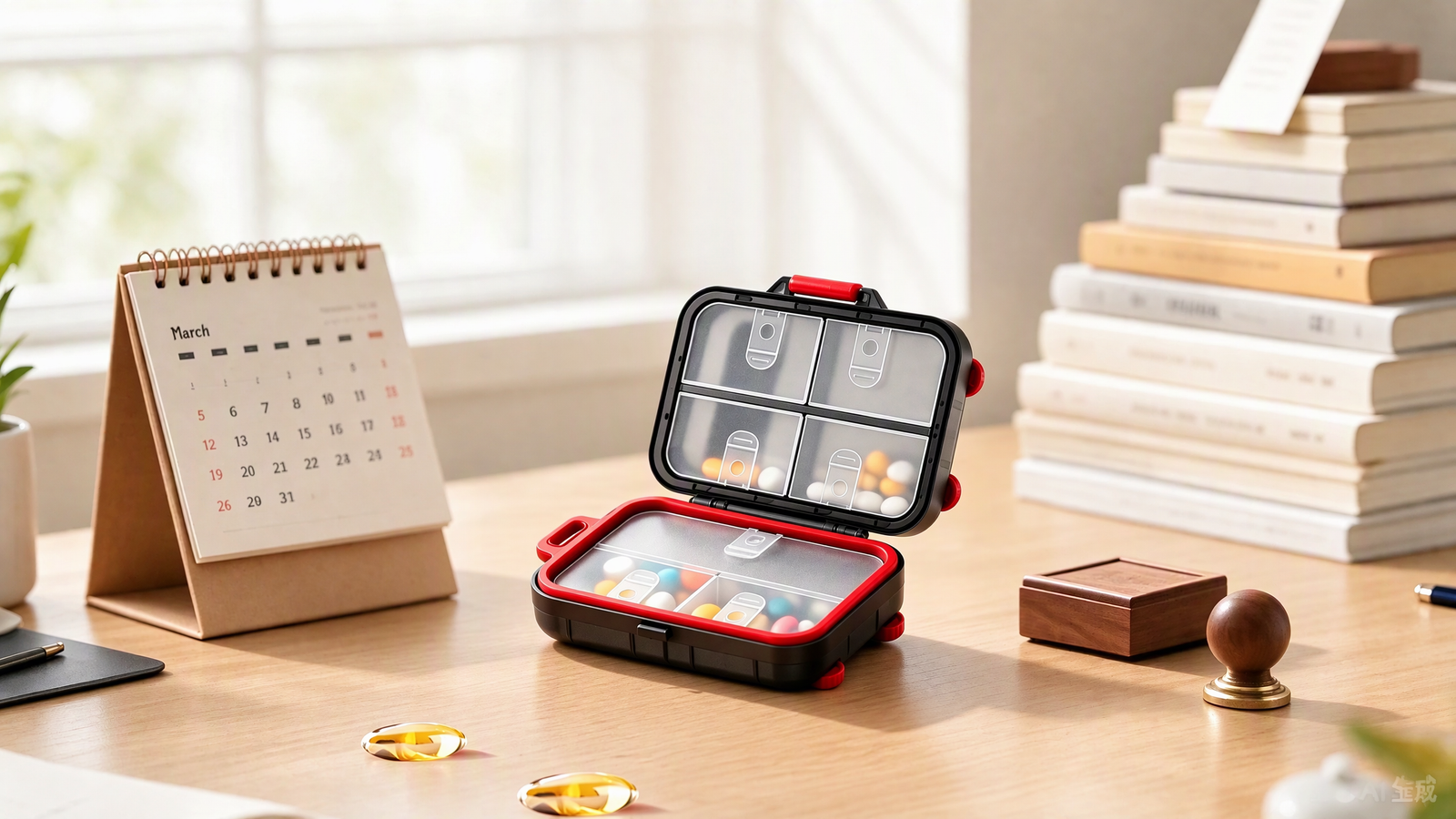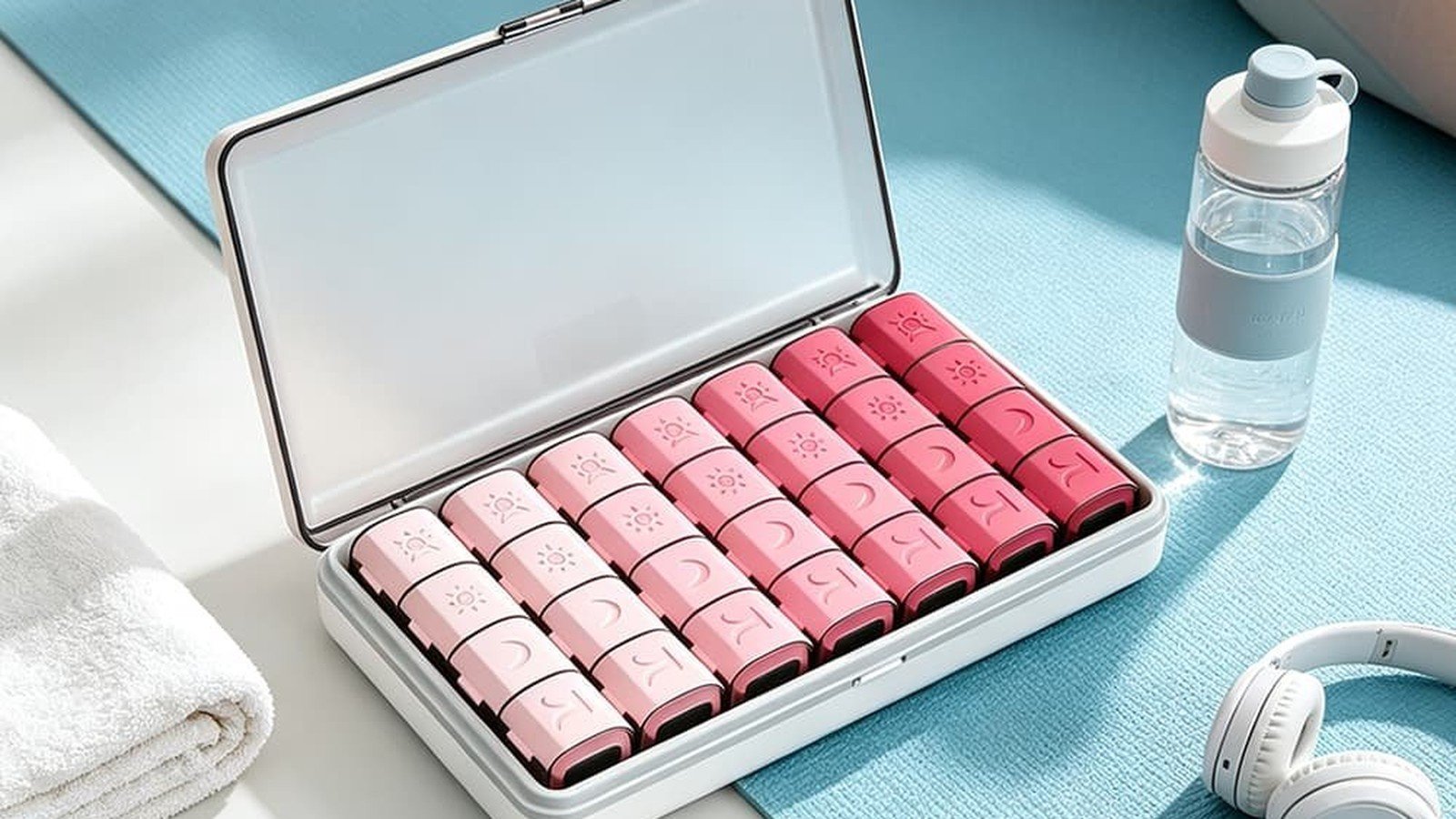






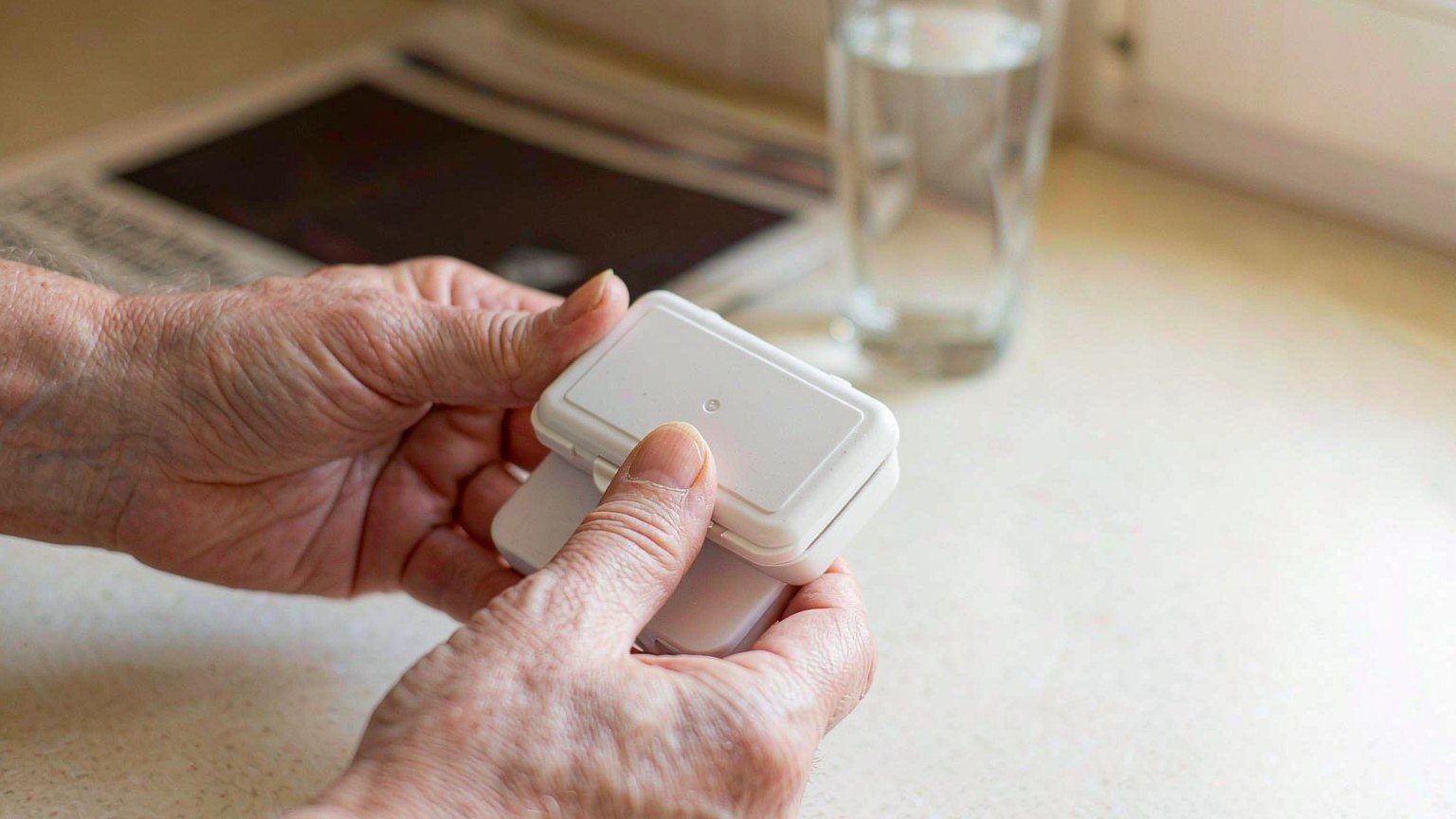
It is seven in the morning. The tablets are in the lid, the water is poured, and the box will not open. You press the tab with your thumb, the way you have done for months, and nothing gives. So you try the edge of a fingernail, then the corner of the table, and now you are late and your hand aches and the dose is still inside.
Most advice about medication routines assumes the box opens. That assumption fails for a large number of people, and it fails quietly — not with a warning label, but with a lid that will not budge on a cold morning when the joints are stiff.
This is not a story about willpower or about getting old. It is about a design trade-off that has been written into packaging for forty years, and about what to check before you buy another box.
The box got safer. Your hands went the other way.
Every improvement in a pill box over the past two decades has pushed in one direction: make it harder to open by accident. Lids that lock instead of snap. Release buttons that only work when the box is held the right way up. Seals tight enough to keep humidity out. Each of those is a real fix for a real failure — a spilled week of doses, a child finding a compartment, a supplement going soft in a bathroom cabinet.
The people using these boxes are moving in the opposite direction. Grip strength declines with age. Arthritis narrows the range of motion in the thumb joint. Neuropathy removes the feedback that tells you how hard you are pressing. A box designed to resist an accidental tug is a box that also resists a hand that cannot tug hard.
Both statements are true at once, and the industry has mostly resolved the conflict in favour of the lock.
The regulations already wrote the trade-off down
You do not have to take this on faith. The United States federal standard for child-resistant packaging contains the trade-off in its own test protocol.
Under 16 CFR 1700.15 and the test procedure in 1700.20, a package passes if at least 85 percent of children cannot open it without a demonstration, and at least 80 percent cannot open it after being shown how. The child panel is given five minutes, a demonstration, then five more minutes. Ten minutes of trying, in total. (16 CFR Part 1700, via the eCFR)
The senior-adult panel — 100 people aged 50 to 70 — is held to a different bar. Senior adult use effectiveness has to reach 90 percent. The first package gets five minutes, including reading the instructions. The second package gets sixty seconds.
Read those numbers side by side. A child is allowed ten minutes to work at the lid. A 65-year-old with arthritic hands gets one minute on the second attempt, and the standard still passes if one in ten of that panel cannot open the package at all.
The rule is not being criticised here. It was written to stop children from being poisoned, and it has done that. The point is narrower: the standard itself assumes that some older adults will fail, and it accepts that as the price of the protection.
Forty years of studies, and the packaging barely moved
The research record on this is small, and one review does most of the work.
A 2022 systematic review in Age and Ageing searched 8,692 studies and found 12 that met its criteria. Every one of them was a direct observational study, because earlier work had already established that what people say they can open and what they can actually open are two different things. The findings held across all twelve: a non-trivial share of participants could not open the packaging in front of them, and the hardest category, consistently, was child-resistant containers. The authors also noted something harder to fix — despite more than forty years of research, the types of packaging being tested had stayed largely the same. (Angel et al., “The neglected barrier to medication use”, Age and Ageing, 2022)
An earlier study makes the gap concrete. Fifty people over 60, living independently, were timed opening fifteen different medication containers. Every single participant could open every container that was not child-resistant. Not one of the child-resistant containers could be opened by all fifty. The difference between the easiest and the hardest child-resistant design, in both success rate and time taken, was large. (Keram & Williams, J Am Geriatr Soc, 1988)
The same question was already being asked in 1985, in a paper whose title has not aged: “Tamper-resistant packaging: is it elder-resistant, too?” (Sherman, J Am Geriatr Soc, 1985)
You probably think you can open it
That mismatch between self-report and actual ability is the part people skip, and it matters if you are shopping for a parent.
Ask someone whether they have trouble with their pill box and the answer is usually no. Hand them a new box and a stopwatch and the answer changes. The 2022 review only included observational studies for exactly this reason — questionnaires had already been shown to overstate ability.
So do not solve this by asking. Solve it by watching. Next time you visit, ask your parent to open the box and take out a dose while you are making tea, and watch their hands rather than their face. Which finger does the work? Does the box need two hands? Do they set it down on a table first? Every one of those is data you cannot get from a phone call.
A pill box is not a child-resistant bottle
Here is an awkward fact about this category: the research is about bottles and blister packs, not about pill organizers. A weekly seven-day box sold in a pharmacy is not governed by 16 CFR 1700 at all. Nobody has to test it against a senior-adult panel, and almost nobody does.
But the design instinct travelled. Boxes are marketed on how securely they close — the harder the better, because “secure” is easy to photograph and easy to claim. Slide-out drawers now ship with release buttons that only release one way up, which stops a week of doses from hitting the floor when the box is carried upside down in a bag (we wrote about that failure here). The mechanism is a genuine improvement. It is also one more thing a weak thumb has to defeat.
The category has spent years adding resistance, and close to none measuring whether the resistance is workable. That is the gap.
How to choose a box your hands can actually work
Forget the material for a minute. Open the box in the shop, or ask for a sample, and run these checks in order.
1. Count the actions. A lid that needs you to press and twist at the same time asks two hands and a strong thumb to cooperate. A lid that needs one push, or one slide, asks for one. Prefer one. This single criterion rules out a lot of the market.
2. Find where the resistance lives. Spring pressure and friction are steady and predictable — you can lean into them. A hard snap-fit that has to be forced past a lip is not; it needs a spike of force, which is exactly what a painful joint cannot deliver.
3. Check the gripping area. Look for a surface wide enough to press with the pad of a thumb rather than a nail, and a body you can hold steady with the other hand. Small, rounded, glossy cases are the worst offenders.
4. Test it wet. Most doses are taken near a sink. A dry-handed test in a shop tells you less than a slightly damp one.
5. Sit down and try it. If opening the box requires standing over a counter with both elbows braced, it will not survive a bad day.
6. Look at what happens after it opens. If you have to tip the box and fish out a tablet, that is a second dexterity task. Compartments that present the dose, or a drawer that slides out with the contents visible, remove it. General sizing criteria are in our guide to choosing a portable organizer, but narrow it first by how it opens.
One more: if the box cannot be taken apart for washing, it will be replaced before it wears out. A liner you can lift out is the difference between a box you clean and a box you stop using (cleaning routine here).
Where our own boxes sit
The honest answer first: we have not run a senior-adult usability panel on any of our products. Nobody in this category has, and we are not going to claim otherwise.
What we can describe is the mechanism, because that is what your hands meet.
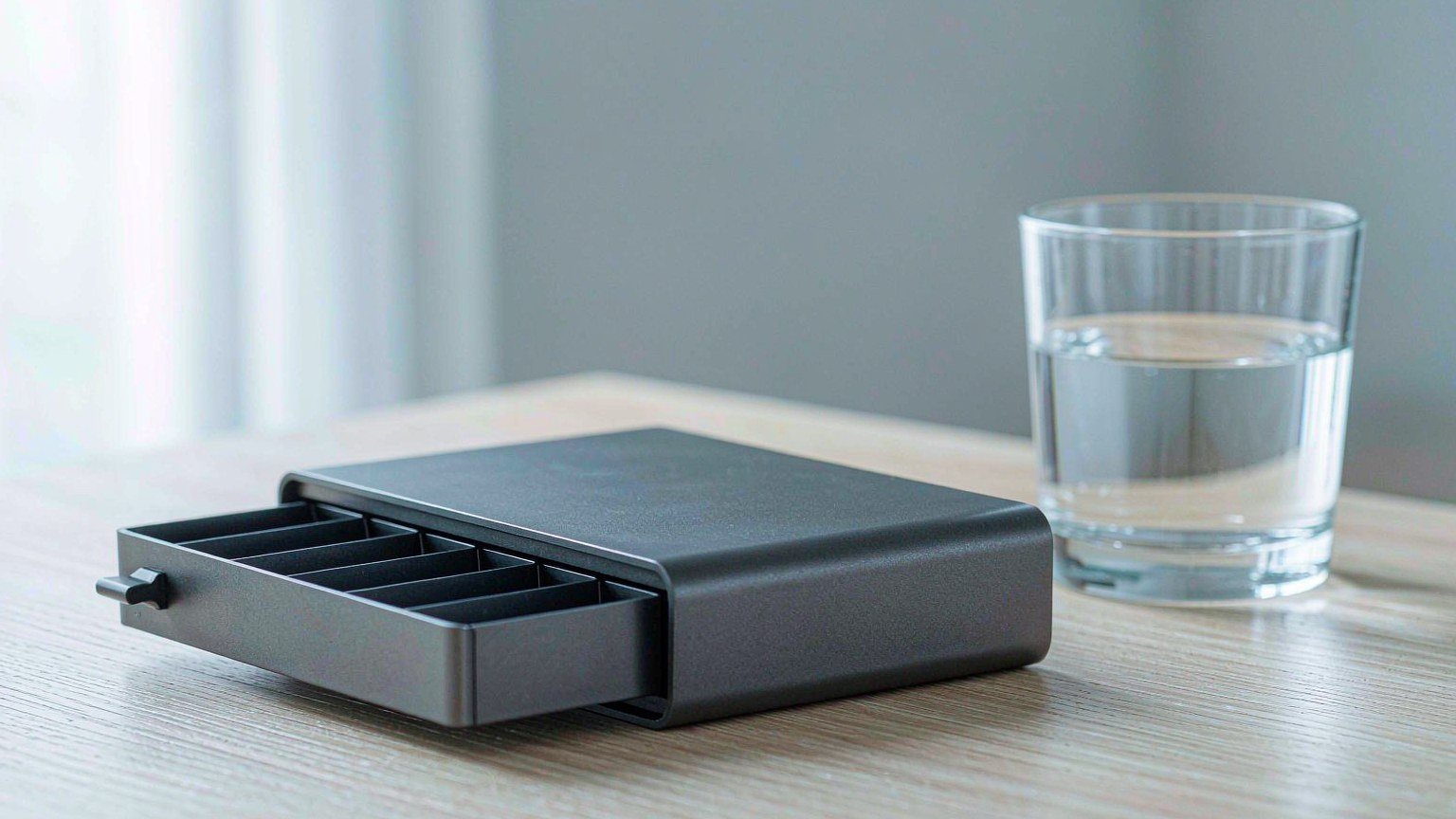
Megastep 2-in-1 メディシンボックス BS1453Jは、2つの便利な収納エリアを1つのコンパクトなデザインに組み合わせています。 Weekly Aluminium Slide-Out Drawer Organizer opens with a release button and a drawer that slides toward you, so the work is a push and a pull rather than prying a lid past a lip. The drawer also seats only one way, which is why it cannot be loaded upside down. That is a description of which motion the box asks for — not a claim that it was tested on arthritic hands, because it was not.
That mechanism was not designed specifically for arthritic hands. If your grip is limited, the only reliable test is your own: ask us for a sample and open it yourself before you commit to a week of doses. That applies to any brand, including this one.
A box that cannot be opened is not a safer box. It is a box that stays shut, and a dose that stays inside it.
This article is general information about product design and usability, not medical advice. If arthritis or another condition is affecting your grip, talk to your doctor or an occupational therapist — an OT can assess your hands and recommend specific opening aids, and that advice will beat anything a product page can tell you.
出典
US Code of Federal Regulations, 16 CFR Part 1700 — Poison Prevention Packaging (test protocol in 1700.20).
Angel M, Bechard L, Pua YH, Thilarajah S, Newton C, Sorensen A, Clark R. The neglected barrier to medication use: a systematic review of difficulties associated with opening medication packaging. Age and Ageing. 2022;51(10):afac225.
Keram S, Williams ME. Quantifying the ease or difficulty older persons experience in opening medication containers. Journal of the American Geriatrics Society. 1988;36(3):198-201.
Sherman FT. Tamper-resistant packaging: is it elder-resistant, too? Journal of the American Geriatrics Society. 1985;33(2):136-141.