





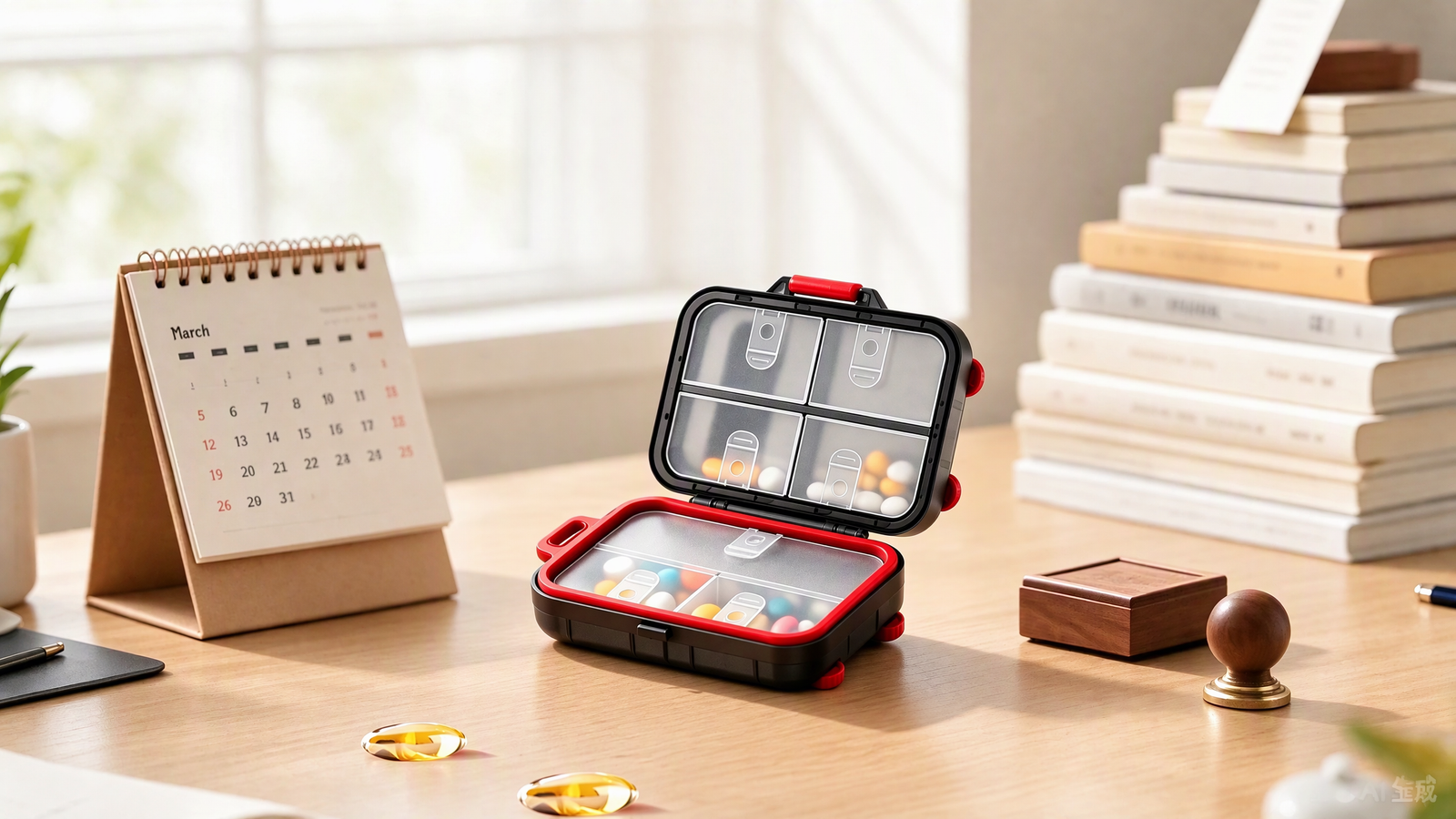
Open someone’s bag and you can usually guess the decade their pill box came from. Clear plastic, seven small lids, a colour that only appears in pharmacies. For most of the past thirty years that was the entire design brief: cheap, see-through, unmistakably medical.
Then look at what is on the shelf now. Brushed aluminium. Goat leather. Marble. A case shaped like a folded suitcase. A hinged box that looks like it should hold mints, or earrings, or nothing at all. The pill case has quietly split into two products: the one you keep in a drawer, and the one you are willing to put on a table.
This is not a story about shame, and it is not a story about willpower. It is a story about what happens to an object when the people who use it stop being patients and start being customers with taste.
Pill cases were jewellery long before they were medical
The plastic box is the historical exception, not the rule. For roughly two centuries, small hinged cases were made from precious metals and set with stones, because carrying one signalled that you could afford what was inside. The Globe and Mail traced the lineage to snuff boxes and patch boxes: gold, enamel, gemstones, and a habit of being pulled out at dinner on purpose. Bill Kime, a decorative arts specialist at the Toronto auction house Waddington’s, describes the logic plainly — a person would produce a small, expensive object mid-meal because it also announced wealth. (The Globe and Mail, “Stylish pillboxes are so hot right now”, June 2026)
The habit never fully died. As the Globe and Mail piece notes, Tiffany & Co. still produces a sterling silver pillbox shaped like a bean, with a gold interior, and Christofle in Paris has been making decorative boxes of this kind since 1830. What happened in the twentieth century was not that the pill box became medical — it is that a cheap injection-moulded version became the default, and the default is what most of us picture when we hear the word.
So the current shift is less a novelty than a return. The object is being designed again, for people who are not in a hospital and have no intention of looking like they are.
What changed in the last few years
Three things, and they compound.
Supplements became a daily habit, not a course of treatment. The market for dietary aids and functional ingredients is projected to approach US$393 billion by 2033, according to a Grand View Research estimate cited by the Globe and Mail. When half the people at a lunch table are taking something — a capsule for gut health, a tablet with food, a magnesium at night — the container stops being a medical device and becomes tableware.
Design brands noticed the gap. Wallpaper* opened its buying guide with a sentence that would have read as absurd in 2015: “Say no to ugly, clinical pill boxes.” The edit that follows runs from a US$35 stainless steel Alessi case to a £295 leather box from Anya Hindmarch, with stops at German aluminium-and-wood, Italian marble, and a US$195 die-cast case with an integrated mirror. (Wallpaper*, “Store supplements in style with these design-friendly pill boxes”)
The price band broke open. A drugstore organizer costs about seven dollars. The design-led ceiling now sits somewhere else entirely: a US$3,550 Tiffany pillbox in sterling silver with a gold interior, an US$11,000 hand-formed nautilus shell from the Los Angeles jeweller Sophie Buhai, a US$265 Christofle bonbonnière, a £35 brass “Sweetie” case from Tooka London. All of them hold a few days of tablets. When the same function sells at four orders of magnitude apart, the category has stopped being one category.
Five design moves that split the category
Look closely at a “designer” pill case and the changes are consistent. They are about material and language, not about how many compartments it has.
| Pharmacy default | Design-led version | |
|---|---|---|
| Material | Injection-moulded polypropylene | Anodised aluminium, stainless steel, brass, leather, marble, wood inlay |
| Form | Flat grid, seven lids in a row | Clutch, wallet, locket, bangle, keyring fob, folding suitcase |
| Colour | Clear, white, institutional blue | Matte black, sand, sage, brushed metal, deliberately dulled finishes |
| Transparency | Fully see-through — the contents are on display | Opaque — what is inside is nobody else’s business |
| Closure | Snap-fit lids that announce themselves | Magnets, threaded caps, damped hinges, silicone-lined seats |
The transparency row is the one people underestimate. A clear box does two jobs at once: it lets you check whether you took today’s dose, and it lets everyone within three metres check too. Making the shell opaque removes the second job. You can still solve the first one with internal dividers, a day wheel, or a lid that opens to one compartment at a time.
The closure row is where design and physics meet. A magnetic lid is elegant and quiet; it is also the first thing to pop open against the lining of a bag. If quiet is what you are optimising for, the mechanism matters more than the finish — we wrote about the difference between “silent” and “merely soft” in this piece on quiet pill boxes.
The part design brands get wrong
A beautiful case that fails at its one job is worse than a plain one that works, because you paid more for the failure. Four things to check before the finish:
- Does the lid stay shut under load? Press the closed case between two fingers the way it sits in a bag. Magnetic closures with no mechanical catch will separate. A threaded cap or a snap with a lip will not.
- Can you get the liner out? Pills shed dust, and a fixed felt or foam insert becomes a permanent trap. Compartments you can lift out are the difference between a case you clean weekly and one you replace yearly — the cleaning routine is here.
- What does metal do in a hot car? An aluminium shell conducts heat far faster than plastic. If the case lives in a glovebox, that material choice works against the contents.
- Does the capacity match the regimen? Most jewellery-style cases hold a day. If you take four things twice a day, you need a week box, and a week box in a locket does not exist. General sizing criteria are in this guide to choosing a portable organizer.
So does a nicer box change anything?
Not the pharmacology. What it changes is whether the box leaves the house.
A dose you left in the kitchen drawer is a dose you miss at two in the afternoon. The Globe and Mail piece makes the case with a detail rather than a statistic: the case that gets carried is the one with “enough presence next to your bread plate to prompt dinner party intrigue.” That is a design outcome — someone chose a form that could survive being seen.
There is a second thread here, and it is not really about design. The artist Karen Cheung started making pillbox pendants and keeps her own prescription in one. Her reason, quoted in the same article, is six words long: “There’s no shame in medicating!” We wrote separately about the psychology of that sentence, and if it is the part that resonates, start there instead.

Where the folding-case shape fits
Most of the design-led pill cases on the market solve one problem: a single day, carried beautifully. If your regimen is a week long, that is not enough, and the pretty options run out.
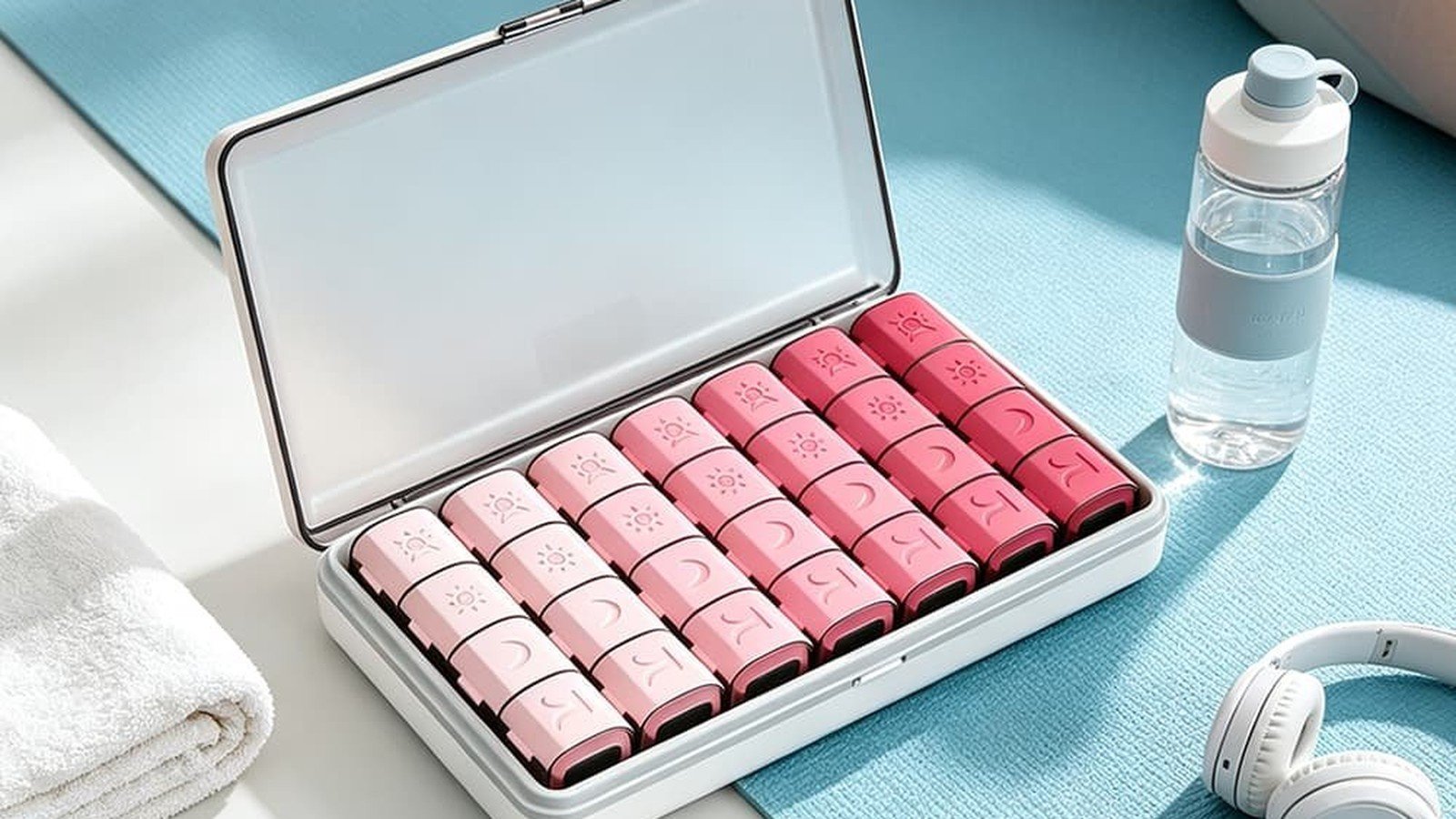
Our Emotion line takes a different route. The 7-Compartment Suitcase Pill Box (BS1568J) is built as a folding case: seven trays hinge together into something the size of a passport holder, then fold flat when it is empty. Closed, it reads as a small piece of luggage rather than a medical product — which is the whole point of the category shift described above. It also holds a full week, which the locket versions cannot.
If the material language is what you are after rather than the form, the Weekly Aluminium Slide-Out Drawer Organizer uses a machined aluminium shell and solves a specific failure of cheap slide-out boxes: the trays can only seat one way, so the box cannot be loaded upside down and spill when you pull it open. And for the people who notice noise more than looks, the Silent Portable Pill Box (BS1564J) puts a silicone seat under each compartment so the capsules stop ticking against the walls.
None of these are jewellery. They are cases designed to be carried without apologising for what they are.
The category spent thirty years pretending a pill box was a piece of medical equipment. It is going back to being an object. That is a better place for it to live — on a table, in a bag, in a pocket, next to the bread plate.
This article is general information about product design, not medical advice. Talk to your pharmacist or doctor about how to store your specific medications.
Fuentes
- The Globe and Mail — “Stylish pill boxes are so hot right now” (design history, Waddington’s commentary, Grand View Research market projection, Karen Cheung)
- Wallpaper* — “Store supplements in style with these design-friendly pill boxes” (design-led market overview and price points)