






Nobody starts a GLP-1 for the supplements. They start it because the appetite is gone and the weight is coming off, and for the first month that is the whole story.
Then the second month arrives with a bag from the pharmacy. A multivitamin someone mentioned in a support group. B12. Vitamin D. Magnesium for the leg cramps. Fibre for the constipation. Protein powder on the counter because the dietitian said the word “protein” four times in one appointment.
The medicine did not add any of those. A smaller plate did. And a smaller plate turns a routine that used to be one pill at breakfast into a schedule that no longer fits in one compartment.
The prescription shrinks the plate and the pill count grows
GLP-1 medications work partly by slowing digestion and reducing appetite, which is why the weight comes off and why the food volume drops with it (Academy of Nutrition and Dietetics). Less food means less of everything the food was carrying. The nutrient requirement does not shrink with the appetite.
How much this matters is now measurable. A 2026 survey of registered dietitians working in weight management and diabetes care reported that roughly 20 percent of people on GLP-1 therapy have vitamin and mineral deficiencies after one year, and that clinicians in this field routinely monitor vitamins A, B12, D, E and C alongside calcium, magnesium, iron, thiamine and zinc. The same survey found that dietitians reach for a multivitamin and mineral supplement when intake is suboptimal — not as a default for everyone, but as a response to a specific gap (Journal of Nutrition).
The supplement industry noticed before most patients did. Innova Market Insights data cited by Nutrition Insight shows supplement launches mentioning GLP-1 grew 67 percent between July 2023 and June 2026, and the products moving into that space are not appetite suppressants — they are protein, fibre, prebiotics and micronutrient blends aimed at people who are eating less but still need to eat well (Nutrition Insight).
That is the shift worth naming. For twenty years, pill organizers were sold to people who had been handed a prescription. This is the first large group arriving at a pill organizer from the supplement side, with products they chose themselves, at doses nobody wrote down, on a schedule nobody assigned.
GLP-1 now comes as a tablet, and that changes the box
On 15 October 2026, the European Medicines Agency’s human medicines committee recommended a marketing authorisation for Foundayo (orforglipron), a once-daily oral GLP-1 for weight management and type 2 diabetes. Two details in the agency’s own summary matter more than the headline. The tablet can be taken at any time of day, with or without food. And the most common side effects — nausea, vomiting and diarrhoea — occur more often while the dose is being increased and become less frequent over time (European Medicines Agency).
An injection has no daily slot. A tablet does. But the label hands you no meal to hang it on, and that is a box-design problem rather than a memory problem. Most weekly organizers are built around breakfast and dinner, because that is how tablets have been taken since tablets existed. A dose that can go at any time has to be given a fixed place anyway, or it drifts — and a dose that drifts is the one that gets skipped on a busy Tuesday.
Pick the slot deliberately and write it down. Morning with the rest of the box is the easy answer for most people; the point is that the slot exists and does not move, not that it is 7 a.m.
What the guidance points at — and what is not a pill
A short list, because this is where supplement marketing tends to run ahead of the evidence.
Protein is the one that matters most, and it is not a compartment item. Guidance for people losing weight on GLP-1 therapy puts protein in the range of 1.2 to 1.5 grams per kilogram of ideal body weight, which is a plate-and-powder problem. No organizer solves it. What an organizer can do is keep the rest of the routine steady while you rebuild meals around protein.
Micronutrients are the ones that end up in the box. B12, vitamin D, iron, calcium, magnesium and zinc are the recurring names in the dietitian survey above. Whether you need any of them, and at what dose, comes from your prescriber or dietitian and ideally from bloodwork — not from a support group thread.
A multivitamin is conditional, not automatic. The dietitian guidance is to consider one when intake is suboptimal, which is a judgment about your diet, not a universal recommendation.
Fibre is real but awkward. Roughly two thirds of the dietitians surveyed reported recommending fibre supplements, mostly for the constipation that comes with slower digestion. Most fibre products are powders or gummies, and neither belongs in a weekly compartment — the powder because it is not a tablet, the gummies because they absorb moisture and turn into a sticky block. We covered that in detail in what should not go in a pill box.
The part a seven-day box was never designed for: hours, not days
Here is the gap that catches people, and it has nothing to do with memory.
Some medication cannot be taken near certain supplements. Levothyroxine is the clearest documented case: it is taken on an empty stomach, 30 to 60 minutes before breakfast, and calcium carbonate or ferrous sulfate — the two most common mineral supplements on the shelf — have to be taken at least four hours before or after it (MedlinePlus).
Four hours is longer than most people’s morning. And a weekly organizer has no way to express it. Every compartment says “these things belong to the same day.” None of them says “these two must not meet for four hours.” Fill your calcium and your thyroid tablet into the same Tuesday morning slot and the box has quietly given you worse instructions than the bottles did.
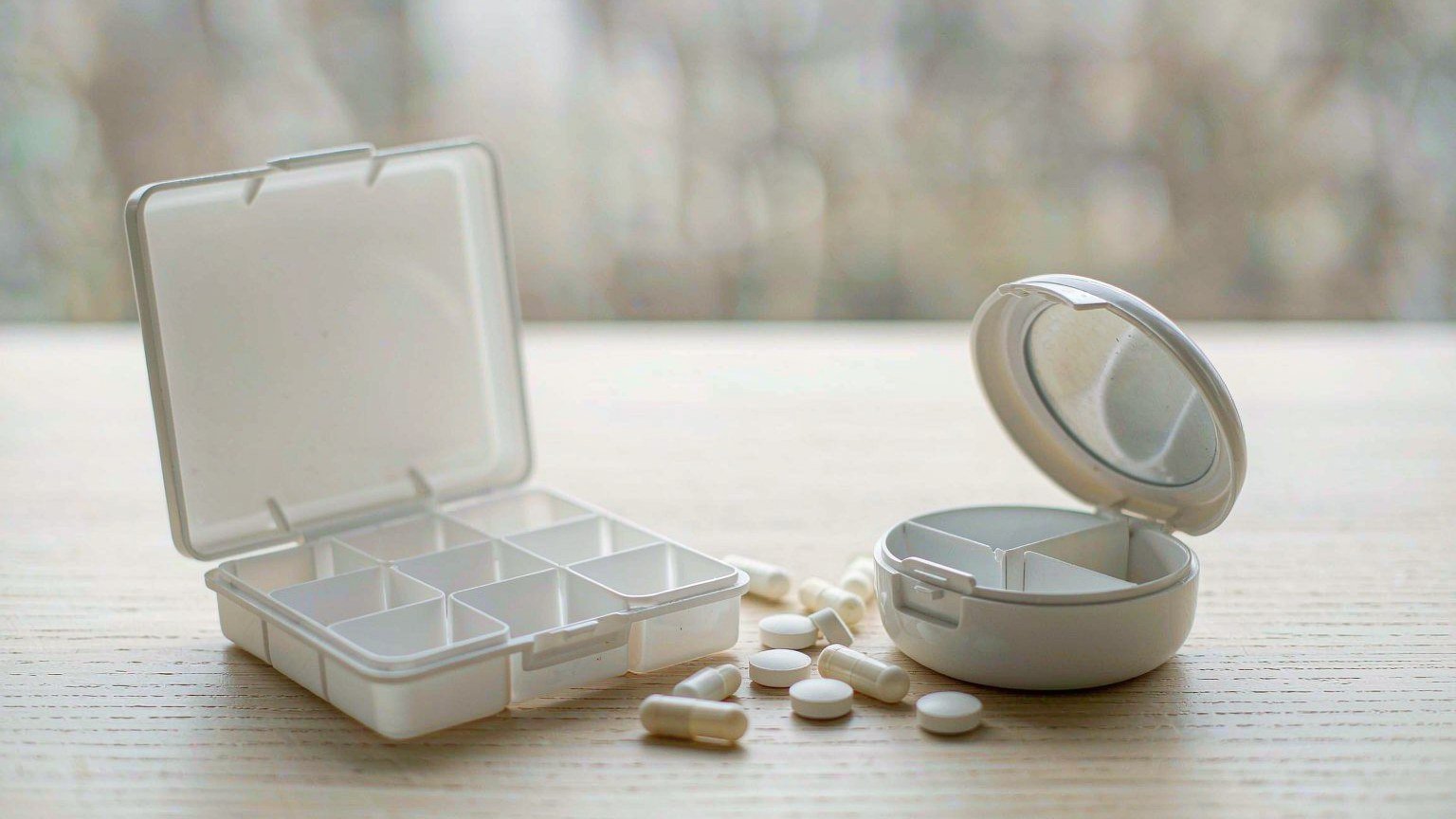
The workable answer is two containers, not a cleverer one. Keep the main weekly box for the things that travel together, and put the ones that need distance in a small separate case — or leave them in their original bottle with the time written on the cap. Two containers with one rule each beat one container pretending to hold a schedule it cannot show.
You do not have to work out which pairs apply to you. Ask the pharmacist one question at pickup: which of these need to be separated, and by how long. It takes a minute and it is the single highest-value question in this article.
The week the dose goes up
Dose-escalation weeks are their own small problem. The agency’s summary is explicit that nausea, vomiting and diarrhoea cluster while the dose is being increased and settle afterwards, which means the hardest week for eating is also the week people stop filling the box.
Three things worth doing in that week:
- Do not add a new supplement in the same week you step up a dose. Two changes at once means you cannot tell which one caused the nausea, the headache or the rash — and you will usually blame the wrong one.
- Keep filling the box even if you eat almost nothing. The compartment is the record. On a week when intake collapses, the filled-then-emptied slot is the only evidence of what happened that you can hand to a clinician.
- Ask before improvising. If a dose comes back up, or a day gets missed, that is a question for the prescriber, not a decision to make at the kitchen counter.
A twenty-minute setup that survives the next change
Four steps, done once, then ten minutes a week.
1. Write two lists, not one. Left column: what a prescriber ordered. Right column: what you added yourself. The right column is the one that never gets written down, and it is the one that grows.
2. Read every label once, and put the constraint on the lid. “Empty stomach.” “Four hours apart from calcium.” “With food.” This is the step people skip, and it is the step that makes the difference between a box that organizes and a box that misinforms.
3. Decide what never enters the box. Softgels, probiotics, gummies, effervescent tablets and anything labelled “protect from light and moisture” stay in the original container. The full reasoning is in the article linked above.
4. Fill on the same day each week, and photograph the filled box. The photo takes four seconds and answers the one question that comes up most often — what was in here on Monday, and did I change anything since.
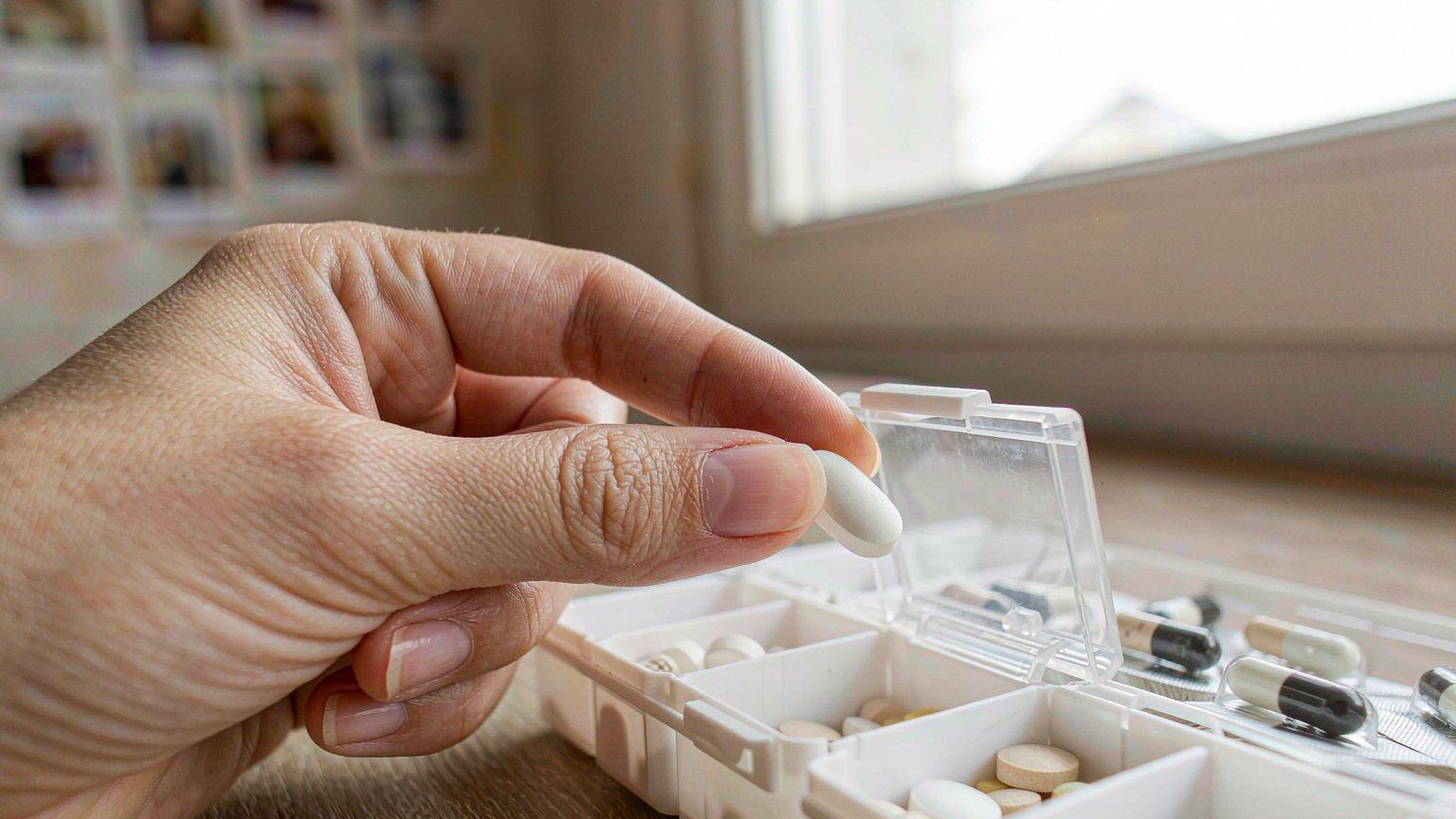
Once a month, wash the box. A 2019 study of used pill organizers tracked microbial contamination rising across the week and falling again after washing (International Journal of Environmental Research and Public Health, 16(20), 3878.), which is a plain argument for making cleaning part of the refill rather than a separate intention. The method, by material, is in how to clean a pill organizer.
When the box is the wrong fix
An organizer fixes the logistics of a routine. It does not fix intake, and it does not replace bloodwork.
If you are persistently tired in a way sleep does not touch, losing hair, noticing tingling in your hands or feet, feeling dizzy when you stand up, or watching your nails go brittle, those are the symptoms that sit alongside the deficiencies dietitians in this field screen for. A better box will not change any of them. Ask for the blood test.
The same applies in the other direction. If the box is being used to stretch a supply, or to hide doses from someone, that is not an organization problem either.
Two boxes, and an honest note about what they do
This is the part where we are selling something, so it will be short and specific.
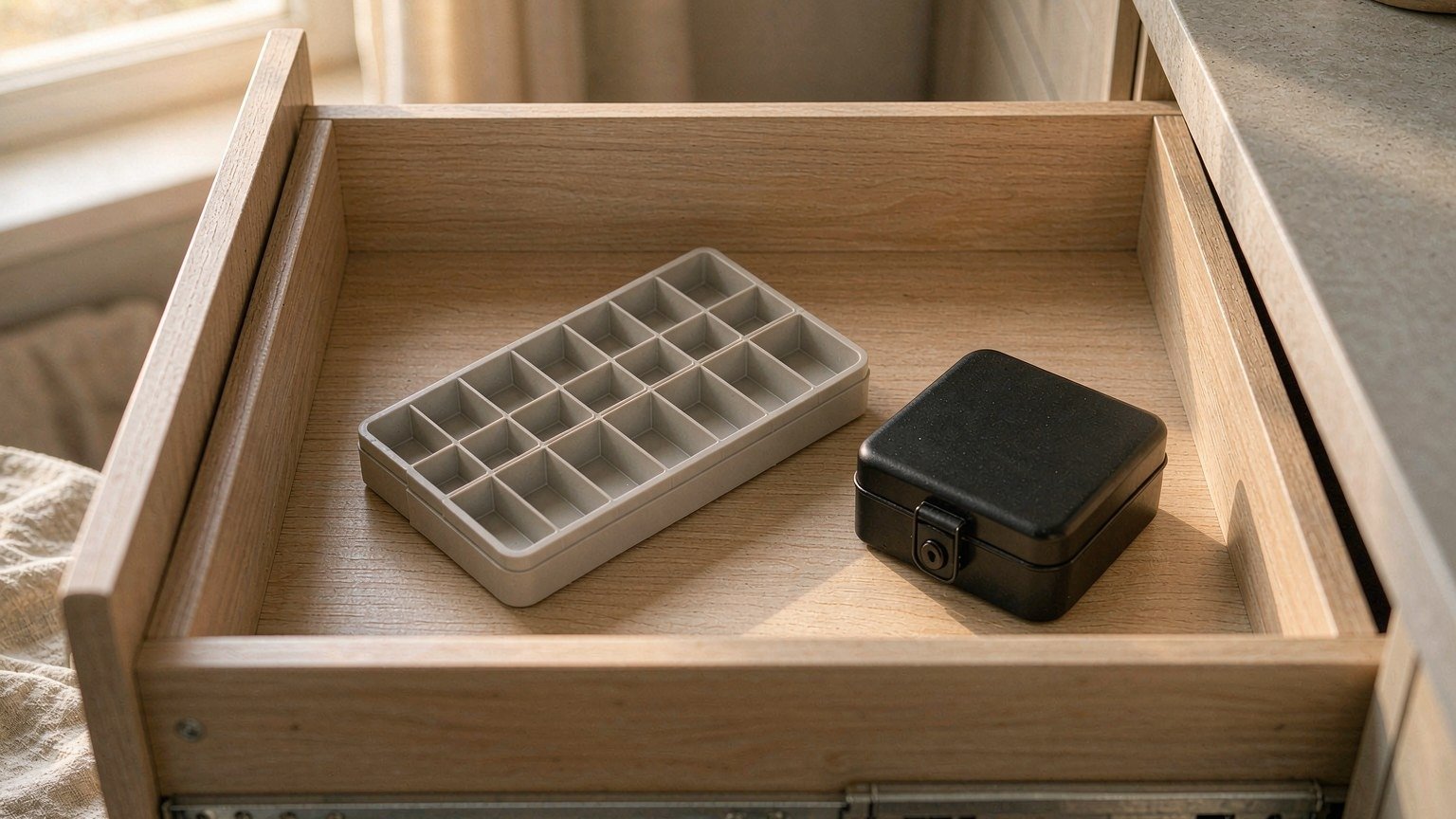
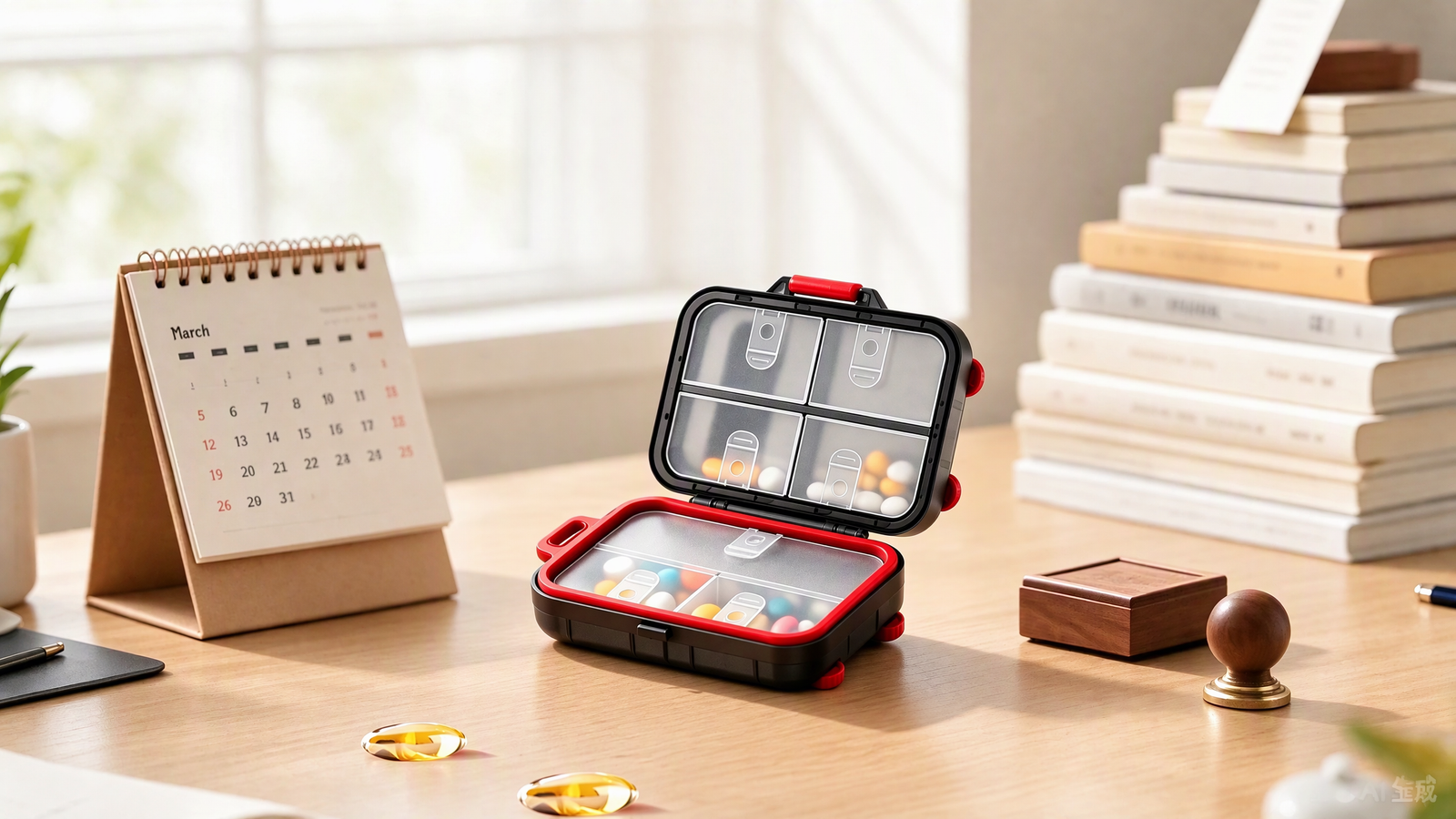
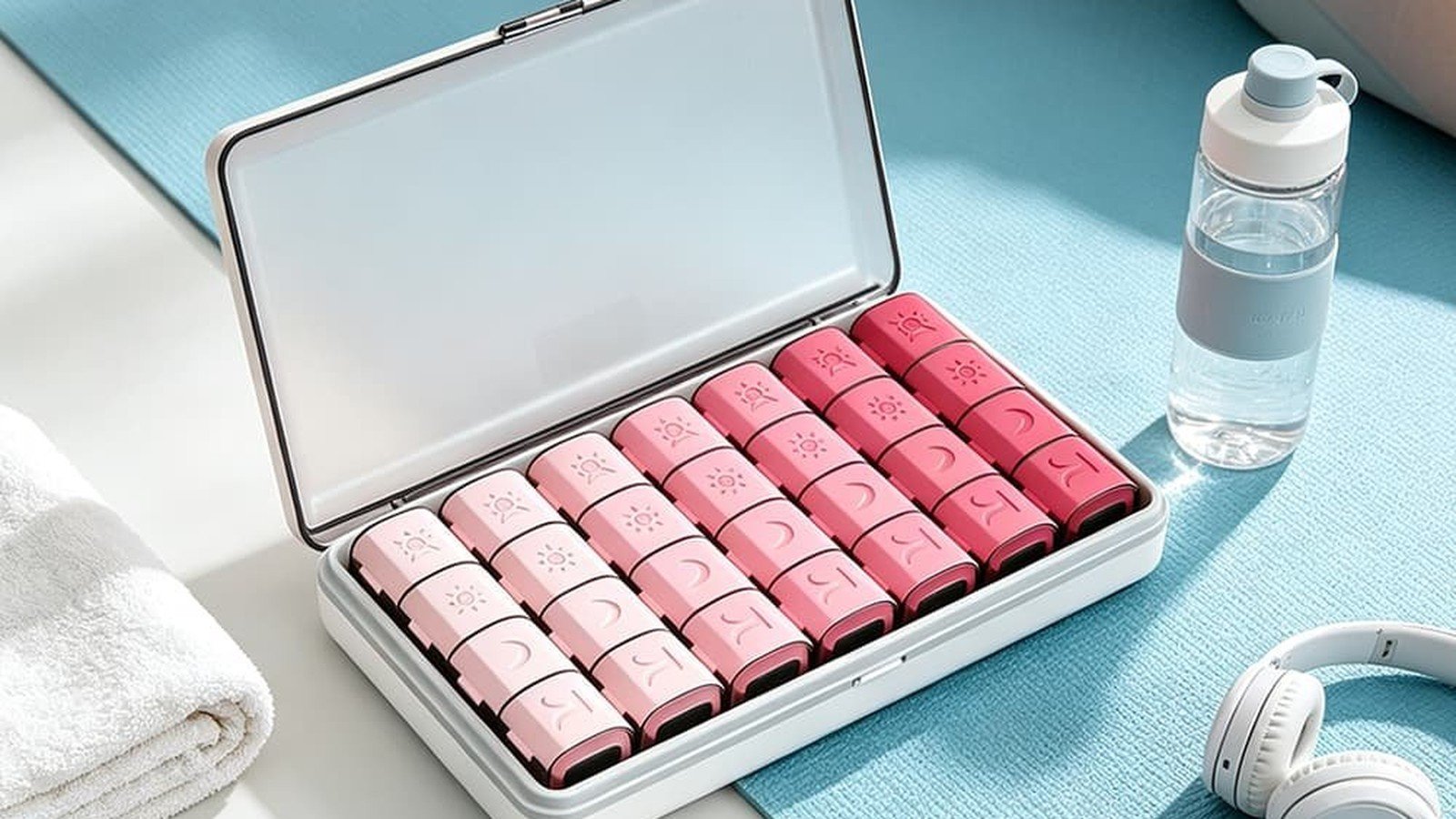
The GLP-1 routine usually needs two containers. For the week itself, our aluminium slide-out organizer holds a full week of twice-daily dosing in a drawer format that does not dump its contents when it is opened the wrong way up — the failure mode of most slide-out boxes. For the second case — the one that holds what has to stay away from the main box, or travels in a bag — the Silent Portable Pill Box BS1564J has four compartments and a silicone liner, so it does not announce itself every time it moves in a bag.
What neither of them does: they do not lock, they do not track adherence, and they will not tell you whether you need B12. If you want the version that does watch, that is a different product category and we wrote about it honestly, including the parts that do not work yet: who can open your pill box.
What they do is hold a week of a routine that got more complicated than anyone warned you about, in one place, quietly, with the constraints written on the lid. That is a smaller promise than the supplement aisle makes. It is also the one we can keep.
This article is general information about organizing medication and supplements, not medical advice. Decisions about what to take, how much, and when belong to your prescriber or dietitian. If you are experiencing persistent fatigue, hair loss, numbness or dizziness while on GLP-1 therapy, raise it with your clinician rather than adjusting supplements on your own.
Quellen
European Medicines Agency. New oral GLP-1 medicine for weight management and type 2 diabetes. CHMP positive opinion for Foundayo (orforglipron) adopted 15 October 2026. (Once-daily tablet; can be taken at any time of day with or without food; nausea, vomiting and diarrhoea most common and more frequent during dose increases.)
Journal of Nutrition (Academy of Nutrition and Dietetics). Cross-Sectional Survey Results of Registered Dietitian Nutritionists … Providing Medical Nutrition Therapy to People Using GLP-1 Receptor Agonist-Based Therapy. 2026. (Roughly 20 percent with vitamin and mineral deficiencies after one year; micronutrients monitored include A, B12, D, E, C, calcium, magnesium, iron, thiamine, zinc; multivitamin and mineral supplement considered when intake is suboptimal; protein 1.2–1.5 g/kg ideal body weight during weight reduction; about two thirds recommend fibre supplements.)
Academy of Nutrition and Dietetics. Beyond Blood Glucose: How GLP-1s are Changing Diabetes Management. (Mechanism: slowed digestion, reduced appetite; long-term nutrition risks including muscle loss with inadequate protein and malnutrition after severe nausea or vomiting.)
Nutrition Insight, citing Innova Market Insights. Protein, fiber and taste drive next wave of GLP-1 companion nutrition. (GLP-1 mentions in supplement launches grew 67 percent from July 2023 to June 2026.)
MedlinePlus, US National Library of Medicine. Levothyroxine. (Taken once a day on an empty stomach, 30 to 60 minutes before breakfast; calcium carbonate or ferrous sulfate at least four hours before or after.)